Asphaug, Erik Author
Biography not available.

Browse all ART CRITICISM books
Browse all Ashworth books
Browse all FOLKLORE books
Browse all GARDENS books
Browse all GRAPHIC NOVELS books
Browse all Hamilton books
Browse all HISTORY - MEDIEVAL books
Browse all HUMOUR books
Browse all Juvenile Fiction : Biographical - Other books
Browse all Juvenile Fiction : Historical - Other books
Browse all Juvenile Fiction : Legends, Myths, & Fables - Other books
Browse all Juvenile Fiction : People & Places - Other books
Browse all Juvenile Fiction : People & Places - United States - Other books
Browse all Juvenile Fiction : Religious - Other books
Browse all Juvenile Nonfiction : History - Other books
Browse all Juvenile Nonfiction : Mathematics - Advanced books
Browse all Juvenile Nonfiction : People & Places - Other books
Browse all Juvenile Nonfiction : People & Places - United States - Othe books
Browse all KINDRED books
Browse all LITERARY STUDIES books
Browse all LONDON books
Browse all Lozada books
Browse all Medical : Nursing - Mental Health books
Browse all MIND books
Browse all MUSEOLOGY books
Browse all NON-CLASSIFIABLE books
Browse all NONLINEAR SCIENCE books
Browse all Ormonde books
Browse all POPULAR SCIENCE books
Browse all RELIGIOUS STUDIES books
Browse all SPIRIT books
Browse all SPORT books
Browse all TRAVEL WRITING books
 Out of Stock
Paperback · ISBN 9780062657930
Inclusive of GST and other taxes
Arriving at your doorstep in 10-15 days
Our logisitcs team will make sure everyitem is delivered safely
| ISBN | 9780062657930 |
|---|---|
| Publisher | Custom House |
| Publication date | August 2023 |
| Language | English |
| MRP | £13.99 GBP |
| Page count | 370 |
| Item weight | 78 g |
An astonishing exploration of planet formation and the origins of life by one of the world's most innovative planetary geologists.
In 1959, the Soviet probe Luna 3 took the first photos of the far side of the moon. Even in their poor resolution, the images stunned scientists: the far side is an enormous mountainous expanse, not the vast lava-plains seen from Earth. Subsequent missions have confirmed this in much greater detail.
How could this be, and what might it tell us about our own place in the universe? As it turns out, quite a lot.
Fourteen billion years ago, the universe exploded into being, creating galaxies and stars. Planets formed out of the leftover dust and gas that coalesced into larger and larger bodies orbiting around each star. In a sort of heavenly survival of the fittest, planetary bodies smashed into each other until solar systems emerged. Curiously, instead of being relatively similar in terms of composition, the planets in our solar system, and the comets, asteroids, satellites and rings, are bewitchingly distinct. So, too, the halves of our moon.
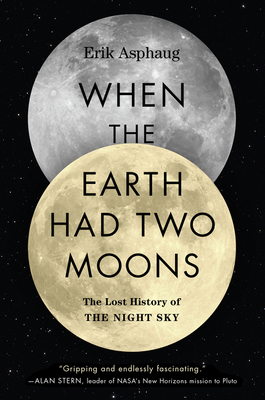
In When the Earth Had Two Moons, esteemed planetary geologist Erik Asphaug takes us on an exhilarating tour through the farthest reaches of time and our galaxy to find out why. Beautifully written and provocatively argued, When the Earth Had Two Moons is not only a mind-blowing astronomical tour but a profound inquiry into the nature of life here--and billions of miles from home.
Log in to write a review for this book.
No reviews yet. Be the first to share your opinion.
Biography not available.