Johnston, Tom Author
Biography not available.

Browse all FOLKLORE books
Browse all GARDENS books
Browse all GRAPHIC NOVELS books
Browse all HISTORY - MEDIEVAL books
Browse all HUMOUR books
Browse all Juvenile Fiction : Biographical - Other books
Browse all Juvenile Fiction : Historical - Other books
Browse all Juvenile Fiction : Legends, Myths, & Fables - Other books
Browse all Juvenile Fiction : People & Places - Other books
Browse all Juvenile Fiction : People & Places - United States - Other books
Browse all Juvenile Fiction : Religious - Other books
Browse all Juvenile Nonfiction : History - Other books
Browse all Juvenile Nonfiction : Mathematics - Advanced books
Browse all Juvenile Nonfiction : People & Places - Other books
Browse all Juvenile Nonfiction : People & Places - United States - Othe books
Browse all LITERARY STUDIES books
Browse all LONDON books
Browse all Medical : Nursing - Mental Health books
Browse all MIND books
Browse all MUSEOLOGY books
Browse all NON-CLASSIFIABLE books
Browse all NONLINEAR SCIENCE books
Browse all POPULAR SCIENCE books
Browse all RELIGIOUS STUDIES books
Browse all SPIRIT books
Browse all SPORT books
Browse all TRAVEL WRITING books
 Out of Stock
MANAGING TIME IN RELATIONAL DA
Hardback · ISBN 9780123750419
Inclusive of GST and other taxes
Arriving at your doorstep in 10-15 days
Our logisitcs team will make sure everyitem is delivered safely
| ISBN | 9780123750419 |
|---|---|
| Subtitle | MANAGING TIME IN RELATIONAL DA |
| Publisher | Morgan Kaufmann Publishers Inc. |
| Publication date | July 2010 |
| Language | English |
| MRP | £58.99 GBP |
| Page count | 504 |
| Item weight | 237 g |
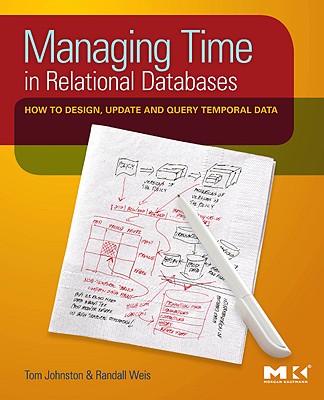
Managing Time in Relational Databases: How to Design, Update and Query Temporal Data introduces basic concepts that will enable businesses to develop their own framework for managing temporal data. It discusses the management of uni-temporal and bi-temporal data in relational databases, so that they can be seamlessly accessed together with current data; the encapsulation of temporal data structures and processes; ways to implement temporal data management as an enterprise solution; and the internalization of pipeline datasets.
The book is organized into three parts. Part 1 traces the history of temporal data management and presents a taxonomy of bi-temporal data management methods. Part 2 provides an introduction to Asserted Versioning, covering the origins of Asserted Versioning; core concepts of Asserted Versioning; the schema common to all asserted version tables, as well as the various diagrams and notations used in the rest of the book; and how the basic scenario works when the target of that activity is an asserted version table. Part 3 deals with designing, maintaining, and querying asserted version databases. It discusses the design of Asserted Versioning databases; temporal transactions; deferred assertions and other pipeline datasets; Allen relationships; and optimizing Asserted Versioning databases.
Log in to write a review for this book.
No reviews yet. Be the first to share your opinion.
Biography not available.
Biography not available.