Shanker, Uma Editor
Biography not available.

Browse all FOLKLORE books
Browse all GARDENS books
Browse all GRAPHIC NOVELS books
Browse all HISTORY - MEDIEVAL books
Browse all HUMOUR books
Browse all Juvenile Fiction : Biographical - Other books
Browse all Juvenile Fiction : Historical - Other books
Browse all Juvenile Fiction : Legends, Myths, & Fables - Other books
Browse all Juvenile Fiction : People & Places - Other books
Browse all Juvenile Fiction : People & Places - United States - Other books
Browse all Juvenile Fiction : Religious - Other books
Browse all Juvenile Nonfiction : History - Other books
Browse all Juvenile Nonfiction : Mathematics - Advanced books
Browse all Juvenile Nonfiction : People & Places - Other books
Browse all Juvenile Nonfiction : People & Places - United States - Othe books
Browse all LITERARY STUDIES books
Browse all LONDON books
Browse all Medical : Nursing - Mental Health books
Browse all MIND books
Browse all MUSEOLOGY books
Browse all NON-CLASSIFIABLE books
Browse all NONLINEAR SCIENCE books
Browse all POPULAR SCIENCE books
Browse all RELIGIOUS STUDIES books
Browse all SPIRIT books
Browse all SPORT books
Browse all TRAVEL WRITING books
 Out of Stock
Paperback · ISBN 9780128231371
Inclusive of GST and other taxes
Arriving at your doorstep in 10-15 days
Our logisitcs team will make sure everyitem is delivered safely
| ISBN | 9780128231371 |
|---|---|
| Publisher | Elsevier |
| Publication date | September 2021 |
| Language | English |
| MRP | £196.00 GBP |
| Page count | 622 |
| Item weight | 233 g |
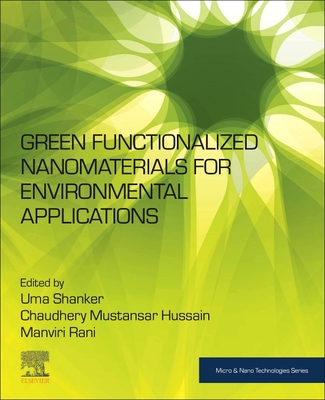
Green nanomaterials are classed as nanomaterials with no environmentally harmful, toxic, properties. The photocatalysis of nanomaterials involves photo-conduction value in efficient removal/degradation of noxious pollutants. Green nanotechnology has objectives for the development of products and processes which are environmentally friendly, economically sustainable, safe, energy-efficient, and produce little waste or emissions. Such products and processes are based on renewable materials and/or have a low net impact on the environment. Green functionalized nanomaterials, formed by a combination of nanomaterials with natural materials or are derived through a green source, are the new trends in the remediation of pollutants in environmental industries. This has the effect of making photoactive nanomaterials work under UV/sunlight radiation in order to produce reactive radical species that rapidly remove pollutants by redox mechanism.
Green Functionalized Nanomaterials for Environmental Applications focuses on recent developments in the area of fabrication of green nanomaterials and their properties. It also looks at ways of lowering the risk of exposure of green functionalized nanomaterials. This needs to be pursued in the future for investigating and assessing health risks, which may be due to exposure to green nanomaterials. It is an important reference source for all those seeking to improve their understanding of how green functionalized nanomaterials are being used in a range of environmental applications, as well as considering potential toxicity implications.
Log in to write a review for this book.
No reviews yet. Be the first to share your opinion.
Biography not available.
Biography not available.
Biography not available.