Schoenbach, Lisi Author
Biography not available.

Browse all FOLKLORE books
Browse all GARDENS books
Browse all GRAPHIC NOVELS books
Browse all HISTORY - MEDIEVAL books
Browse all HUMOUR books
Browse all Juvenile Fiction : Biographical - Other books
Browse all Juvenile Fiction : Historical - Other books
Browse all Juvenile Fiction : Legends, Myths, & Fables - Other books
Browse all Juvenile Fiction : People & Places - Other books
Browse all Juvenile Fiction : People & Places - United States - Other books
Browse all Juvenile Fiction : Religious - Other books
Browse all Juvenile Nonfiction : History - Other books
Browse all Juvenile Nonfiction : Mathematics - Advanced books
Browse all Juvenile Nonfiction : People & Places - Other books
Browse all Juvenile Nonfiction : People & Places - United States - Othe books
Browse all LITERARY STUDIES books
Browse all LONDON books
Browse all Medical : Nursing - Mental Health books
Browse all MIND books
Browse all MUSEOLOGY books
Browse all NON-CLASSIFIABLE books
Browse all NONLINEAR SCIENCE books
Browse all POPULAR SCIENCE books
Browse all RELIGIOUS STUDIES books
Browse all SPIRIT books
Browse all SPORT books
Browse all TRAVEL WRITING books
 Out of Stock
PRAGMATIC MODERNISM
Paperback · ISBN 9780190207342
Inclusive of GST and other taxes
Arriving at your doorstep in 10-15 days
Our logisitcs team will make sure everyitem is delivered safely
| ISBN | 9780190207342 |
|---|---|
| Subtitle | PRAGMATIC MODERNISM |
| Publisher | Oxford University Press |
| Publication date | December 2014 |
| Language | English |
| MRP | £43.99 GBP |
| Page count | 218 |
| Item weight | 76 g |
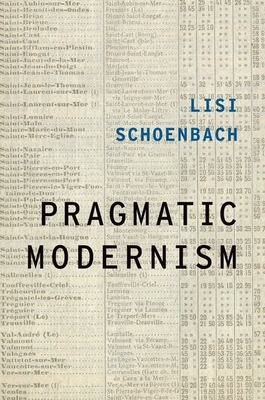
Through its analysis of pragmatist keywords, including "habit," "institution," "prediction," and "bigness," Pragmatic Modernism offers new readings of works by James, Proust, Stein, and Andre Breton, among others. It shows, for instance, how Stein's characteristic literary innovation--her repetitions--aesthetically materialize the problem of habit; and how institutions--businesses, museums, newspapers, the law, and even the state itself--help to construct the subtlest of personal observations and private gestures in James's novels.
This study reconstructs an overlooked strain of modernism. In so doing, it helps to re-imagine the stark choice between political quietism and total revolution that has been handed down as modernism's legacy.
Log in to write a review for this book.
No reviews yet. Be the first to share your opinion.
Biography not available.