Bloom Jr, Lackland H Author
Biography not available.

Browse all ART CRITICISM books
Browse all Ashworth books
Browse all FOLKLORE books
Browse all GARDENS books
Browse all GRAPHIC NOVELS books
Browse all Hamilton books
Browse all HISTORY - MEDIEVAL books
Browse all HUMOUR books
Browse all KINDRED books
Browse all LITERARY STUDIES books
Browse all LONDON books
Browse all Lozada books
Browse all Medical : Nursing - Mental Health books
Browse all MIND books
Browse all MUSEOLOGY books
Browse all NON-CLASSIFIABLE books
Browse all NONLINEAR SCIENCE books
Browse all Ormonde books
Browse all POPULAR SCIENCE books
Browse all RELIGIOUS STUDIES books
Browse all SPIRIT books
Browse all SPORT books
Browse all TRAVEL WRITING books
 Out of Stock
Paperback · ISBN 9780190840082
Inclusive of GST and other taxes
Arriving at your doorstep in 10-15 days
Our logisitcs team will make sure everyitem is delivered safely
| ISBN | 9780190840082 |
|---|---|
| Publisher | Oxford University Press |
| Publication date | August 2017 |
| Language | English |
| MRP | £37.99 GBP |
| Page count | 452 |
| Item weight | 152 g |
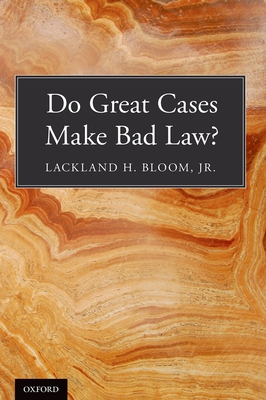
Lackland H. Bloom, Jr. tests Justice Holmes' dictum in Do Great Cases Make Bad Law? He analyzes in detail the history of the Supreme Court's great cases, from Marbury v. Madison in 1803, to National Federation of Independent Business v. Sebelius, the Patient Protection and Affordable Care Act case in 2012. He treats each case with its own chapter, and explains why the Court found a case compelling, how the background and historical context affected the decision and its place in constitutional law and history, how academic scholarship has treated the case, and how the case integrates with and reflects off of Justice Holmes' famous statement. In doing so, Professor Bloom draws on the whole of the Supreme Court's decisional history to form an intricate scholarly understanding of the holistic significance of the Court's reasoning in American constitutional law.
Log in to write a review for this book.
No reviews yet. Be the first to share your opinion.
Biography not available.