Halpern, Jodi Author
Biography not available.

Browse all FOLKLORE books
Browse all GARDENS books
Browse all GRAPHIC NOVELS books
Browse all HISTORY - MEDIEVAL books
Browse all HUMOUR books
Browse all Juvenile Fiction : Biographical - Other books
Browse all Juvenile Fiction : Historical - Other books
Browse all Juvenile Fiction : Legends, Myths, & Fables - Other books
Browse all Juvenile Fiction : People & Places - Other books
Browse all Juvenile Fiction : People & Places - United States - Other books
Browse all Juvenile Fiction : Religious - Other books
Browse all Juvenile Nonfiction : History - Other books
Browse all Juvenile Nonfiction : Mathematics - Advanced books
Browse all Juvenile Nonfiction : People & Places - Other books
Browse all Juvenile Nonfiction : People & Places - United States - Othe books
Browse all LITERARY STUDIES books
Browse all LONDON books
Browse all Medical : Nursing - Mental Health books
Browse all MIND books
Browse all MUSEOLOGY books
Browse all NON-CLASSIFIABLE books
Browse all NONLINEAR SCIENCE books
Browse all POPULAR SCIENCE books
Browse all RELIGIOUS STUDIES books
Browse all SPIRIT books
Browse all SPORT books
Browse all TRAVEL WRITING books
 Out of Stock
FROM DETACHED CONCERN TO EMPAT
Hardback · ISBN 9780195111194
Inclusive of GST and other taxes
Arriving at your doorstep in 10-15 days
Our logisitcs team will make sure everyitem is delivered safely
| ISBN | 9780195111194 |
|---|---|
| Subtitle | FROM DETACHED CONCERN TO EMPAT |
| Publisher | Oxford University Press |
| Publication date | May 2001 |
| Language | English |
| MRP | £75.00 GBP |
| Page count | 188 |
| Item weight | 99 g |
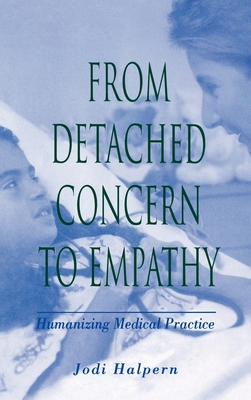
How can doctors use empathy in diagnosing and treating patients rithout jeopardizing objectivity or projecting their values onto patients? Jodi Halpern, a psychiatrist, medical ethicist and philosopher, develops a groundbreaking account of emotional reasoning as the core of clinical empathy. She argues that empathy cannot be based on detached reasoning because it involves emotional skills, including associating with another person's images and spontaneously following another's mood shifts. Yet she argues that these emotional links need not lead to over-identifying with patients or other lapses in rationality but rather can inform medical judgement in ways that detached reasoning cannot. For reflective physicians and discerning patients, this book provides a road map for cultivating empathy in medical practice. For a more general audience, it addresses a basic human question: how can one person's emotions lead to an understanding of how another person is feeling?
Log in to write a review for this book.
No reviews yet. Be the first to share your opinion.
Biography not available.