Shapiro, Stewart Author
Biography not available.

Browse all ART CRITICISM books
Browse all Ashworth books
Browse all FOLKLORE books
Browse all GARDENS books
Browse all GRAPHIC NOVELS books
Browse all Hamilton books
Browse all HISTORY - MEDIEVAL books
Browse all HUMOUR books
Browse all KINDRED books
Browse all LITERARY STUDIES books
Browse all LONDON books
Browse all Lozada books
Browse all Medical : Nursing - Mental Health books
Browse all MIND books
Browse all MUSEOLOGY books
Browse all NON-CLASSIFIABLE books
Browse all NONLINEAR SCIENCE books
Browse all Ormonde books
Browse all POPULAR SCIENCE books
Browse all RELIGIOUS STUDIES books
Browse all SPIRIT books
Browse all SPORT books
Browse all TRAVEL WRITING books
 Out of Stock
FOUNDATIONS W/O FOUNDATIONALIS
Paperback · ISBN 9780198250296
Inclusive of GST and other taxes
Arriving at your doorstep in 10-15 days
Our logisitcs team will make sure everyitem is delivered safely
| ISBN | 9780198250296 |
|---|---|
| Subtitle | FOUNDATIONS W/O FOUNDATIONALIS |
| Publisher | OUP Oxford |
| Publication date | November 1999 |
| Language | English |
| MRP | £59.00 GBP |
| Page count | 300 |
| Item weight | 94 g |
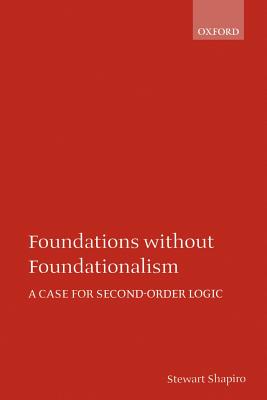
The central contention of this book is that second-order logic has a central role to play in laying the foundations of mathematics. In order to develop the argument fully, the author presents a detailed description of higher-order logic, including a comprehensive discussion of its semantics. He goes on to demonstrate the prevalence of second-order concepts in mathematics and the extent to which mathematical ideas can be formulated in higher-order logic. He also shows how first-order languages are often insufficient to codify many concepts in contemporary mathematics, and thus that both first- and higher-order logics are needed to fully reflect current work. Throughout, the emphasis is on discussing the associated philosophical and historical issues and the implications they have for foundational studies. For the most part, the author assumes little more than a familiarity with logic comparable to that provided in a beginning graduate course which includes the incompleteness of arithmetic and the Lowenheim-Skolem theorems. All those concerned with the foundations of mathematics will find this a thought-provoking discussion of some of the central issues in the field today.
Log in to write a review for this book.
No reviews yet. Be the first to share your opinion.
Biography not available.