Turing, Alan Mathison Author
Biography not available.

Browse all ART CRITICISM books
Browse all Ashworth books
Browse all FOLKLORE books
Browse all GARDENS books
Browse all GRAPHIC NOVELS books
Browse all Hamilton books
Browse all HISTORY - MEDIEVAL books
Browse all HUMOUR books
Browse all KINDRED books
Browse all LITERARY STUDIES books
Browse all LONDON books
Browse all Lozada books
Browse all Medical : Nursing - Mental Health books
Browse all MIND books
Browse all MUSEOLOGY books
Browse all NON-CLASSIFIABLE books
Browse all NONLINEAR SCIENCE books
Browse all Ormonde books
Browse all POPULAR SCIENCE books
Browse all RELIGIOUS STUDIES books
Browse all SPIRIT books
Browse all SPORT books
Browse all TRAVEL WRITING books
 Out of Stock
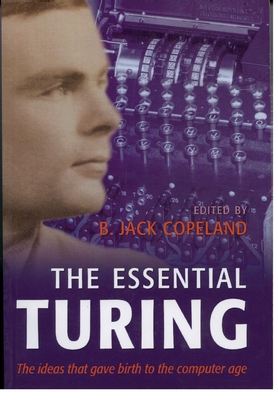
ESSENTIAL TURING
Paperback · ISBN 9780198250807
Inclusive of GST and other taxes
Arriving at your doorstep in 10-15 days
Our logisitcs team will make sure everyitem is delivered safely
| ISBN | 9780198250807 |
|---|---|
| Subtitle | ESSENTIAL TURING |
| Publisher | Oxford University Press(UK) |
| Publication date | June 2013 |
| Language | English |
| MRP | £31.99 GBP |
| Page count | 622 |
| Item weight | 190 g |
At the outbreak of hostilities with Germany in September 1939, he joined the Government Codebreaking team at Bletchley Park, Buckinghamshire and played a crucial role in deciphering Engima, the code used by the German armed forces to protect their radio communications. Turing's work on the version of Enigma used by the German navy was vital to the battle for supremacy in the North Atlantic. He also contributed to the attack on the cyphers known as "Fish," which were used by the German High Command for the encryption of signals during the latter part of the war. His contribution helped to shorten the war in Europe by an estimated two years.
After the war, his theoretical work led to the development of Britain's first computers at the National Physical Laboratory and the Royal Society Computing Machine Laboratory at Manchester University.
Turing was also a founding father of modern cognitive science, theorizing that the cortex at birth is an "unorganized machine" which through "training" becomes organized "into a universal machine or something like it." He went on to develop the use of computers to model biological growth, launching the discipline now referred to as Artificial Life.
The papers in this book are the key works for understanding Turing's phenomenal contribution across all these fields. The collection includes Turing's declassified wartime "Treatise on the Enigma"; letters from Turing to Churchill and to codebreakers; lectures, papers, and broadcasts which opened up the concept of AI and its implications; and the paper which formed the genesis of the investigation of Artifical Life.
Log in to write a review for this book.
No reviews yet. Be the first to share your opinion.
Biography not available.
Biography not available.
Biography not available.