Trappenberg, Thomas Author
Biography not available.

Browse all FOLKLORE books
Browse all GARDENS books
Browse all GRAPHIC NOVELS books
Browse all HISTORY - MEDIEVAL books
Browse all HUMOUR books
Browse all Juvenile Fiction : Biographical - Other books
Browse all Juvenile Fiction : Historical - Other books
Browse all Juvenile Fiction : Legends, Myths, & Fables - Other books
Browse all Juvenile Fiction : People & Places - Other books
Browse all Juvenile Fiction : People & Places - United States - Other books
Browse all Juvenile Fiction : Religious - Other books
Browse all Juvenile Nonfiction : History - Other books
Browse all Juvenile Nonfiction : Mathematics - Advanced books
Browse all Juvenile Nonfiction : People & Places - Other books
Browse all Juvenile Nonfiction : People & Places - United States - Othe books
Browse all LITERARY STUDIES books
Browse all LONDON books
Browse all Medical : Nursing - Mental Health books
Browse all MIND books
Browse all MUSEOLOGY books
Browse all NON-CLASSIFIABLE books
Browse all NONLINEAR SCIENCE books
Browse all POPULAR SCIENCE books
Browse all RELIGIOUS STUDIES books
Browse all SPIRIT books
Browse all SPORT books
Browse all TRAVEL WRITING books
 Out of Stock
Paperback · ISBN 9780198828044
Inclusive of GST and other taxes
Arriving at your doorstep in 10-15 days
Our logisitcs team will make sure everyitem is delivered safely
| ISBN | 9780198828044 |
|---|---|
| Publisher | OXFORD UNIV PR |
| Publication date | January 2020 |
| Language | English |
| MRP | £45.99 GBP |
| Page count | 260 |
| Item weight | 104 g |
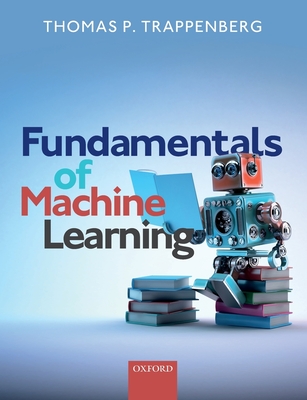
This book is a brief introduction to this area - exploring its importance in a range of many disciplines, from science to engineering, and even its broader impact on our society. The book is written in a style that strikes a balance between brevity of explanation, rigorous mathematical argument, and outlines principle ideas. At the same time, it provides a comprehensive overview of a variety of methods and their application within this field. This includes an introduction to Bayesian approaches to modeling, as well as deep learning.
Writing small programs to apply machine learning techniques is made easy by high level programming systems, and this book shows examples in Python with the machine learning libraries 'sklearn' and 'Keras'. The first four chapters concentrate on the practical side of applying machine learning techniques. The following four chapters discuss more fundamental concepts that includes their formulation in a probabilistic context. This is followed by two more chapters on advanced models, that of recurrent neural networks and that of reinforcement learning. The book closes with a brief discussion on the impact of machine learning and AI on our society.
Fundamentals of Machine Learning provides a brief and accessible introduction to this rapidly growing field, one that will appeal to students and researchers across computer science and computational neuroscience, as well as the broader cognitive sciences.
Log in to write a review for this book.
No reviews yet. Be the first to share your opinion.
Biography not available.