Gisborne, Nikolas Author
Biography not available.

Browse all FOLKLORE books
Browse all GARDENS books
Browse all GRAPHIC NOVELS books
Browse all HISTORY - MEDIEVAL books
Browse all HUMOUR books
Browse all Juvenile Fiction : Biographical - Other books
Browse all Juvenile Fiction : Historical - Other books
Browse all Juvenile Fiction : Legends, Myths, & Fables - Other books
Browse all Juvenile Fiction : People & Places - Other books
Browse all Juvenile Fiction : People & Places - United States - Other books
Browse all Juvenile Fiction : Religious - Other books
Browse all Juvenile Nonfiction : History - Other books
Browse all Juvenile Nonfiction : Mathematics - Advanced books
Browse all Juvenile Nonfiction : People & Places - Other books
Browse all Juvenile Nonfiction : People & Places - United States - Othe books
Browse all LITERARY STUDIES books
Browse all LONDON books
Browse all Medical : Nursing - Mental Health books
Browse all MIND books
Browse all MUSEOLOGY books
Browse all NON-CLASSIFIABLE books
Browse all NONLINEAR SCIENCE books
Browse all POPULAR SCIENCE books
Browse all RELIGIOUS STUDIES books
Browse all SPIRIT books
Browse all SPORT books
Browse all TRAVEL WRITING books
 Out of Stock
EVENT STRUCTURE OF PERCEPTION
Hardback · ISBN 9780199577798
Inclusive of GST and other taxes
Arriving at your doorstep in 10-15 days
Our logisitcs team will make sure everyitem is delivered safely
| ISBN | 9780199577798 |
|---|---|
| Subtitle | EVENT STRUCTURE OF PERCEPTION |
| Publisher | OUP Oxford |
| Publication date | May 2010 |
| Language | English |
| MRP | £125.00 GBP |
| Page count | 330 |
| Item weight | 141 g |
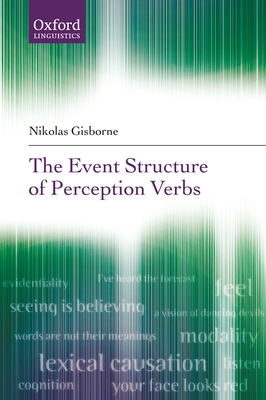
After an opening chapter explaining the nature of the issues, Dr Gisborne presents a concise introduction to Word Grammar. He then considers the implications of his approach for a general theory of event structure. He looks at how the framework may be applied to causation, argument linking, and the modelling of polysemy. He examines the semantic similarities and differences between listen- and hear-class verbs, and analyses the cognate patterns of sound-class verbs. He concludes by drawing together his findings and exploring their implications for linguistic theory.
Clearly and readably written, with each point of the argument illustrated with well-chosen examples, this book will appeal to linguists of all theoretical persuasions at graduate level and above.
Log in to write a review for this book.
No reviews yet. Be the first to share your opinion.
Biography not available.