Elbourne, Paul Author
Biography not available.

Browse all ART CRITICISM books
Browse all Ashworth books
Browse all FOLKLORE books
Browse all GARDENS books
Browse all GRAPHIC NOVELS books
Browse all Hamilton books
Browse all HISTORY - MEDIEVAL books
Browse all HUMOUR books
Browse all KINDRED books
Browse all LITERARY STUDIES books
Browse all LONDON books
Browse all Lozada books
Browse all Medical : Nursing - Mental Health books
Browse all MIND books
Browse all MUSEOLOGY books
Browse all NON-CLASSIFIABLE books
Browse all NONLINEAR SCIENCE books
Browse all Ormonde books
Browse all POPULAR SCIENCE books
Browse all RELIGIOUS STUDIES books
Browse all SPIRIT books
Browse all SPORT books
Browse all TRAVEL WRITING books
 Out of Stock
Paperback · ISBN 9780199660209
Inclusive of GST and other taxes
Arriving at your doorstep in 10-15 days
Our logisitcs team will make sure everyitem is delivered safely
| ISBN | 9780199660209 |
|---|---|
| Publisher | OUP Oxford |
| Publication date | June 2013 |
| Language | English |
| MRP | £49.99 GBP |
| Page count | 262 |
| Item weight | 94 g |
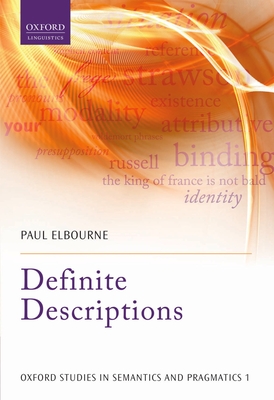
This book argues that definite descriptions ('the table', 'the King of France') refer to individuals, as Gottlob Frege claimed. This apparently simple conclusion flies in the face of philosophical orthodoxy, which incorporates Bertrand Russell's theory that definite descriptions are devices of quantification. Paul Elbourne presents the first fully-argued defence of the Fregean view. He builds an explicit fragment of English using a version of situation semantics. He uses intrinsic aspects of his system to account for the presupposition projection behaviour of definite descriptions, a range of modal properties, and the problem of incompleteness. At the same time, he draws on an unusually wide range of linguistic and philosophical literature, from early work by Frege, Peano, and Russell to the latest findings in linguistics, philosophy of language, and psycholinguistics. His penultimate chapter addresses the semantics of pronouns and offers a new and more radical version of his earlier thesis that they too are Fregean definite descriptions.
Log in to write a review for this book.
No reviews yet. Be the first to share your opinion.
Biography not available.