Saywitz, Karen J. Author
Biography not available.

Browse all ART CRITICISM books
Browse all Ashworth books
Browse all BUSINESS AND ECONOMICS books
Browse all FOLKLORE books
Browse all GARDENS books
Browse all GRAPHIC NOVELS books
Browse all HISTORY - MEDIEVAL books
Browse all HUMOUR books
Browse all Juvenile Fiction : Biographical - Other books
Browse all Juvenile Fiction : Historical - Other books
Browse all Juvenile Fiction : Legends, Myths, & Fables - Other books
Browse all Juvenile Fiction : People & Places - Other books
Browse all Juvenile Fiction : People & Places - United States - Other books
Browse all Juvenile Fiction : Religious - Other books
Browse all Juvenile Nonfiction : History - Other books
Browse all Juvenile Nonfiction : Mathematics - Advanced books
Browse all Juvenile Nonfiction : People & Places - Other books
Browse all Juvenile Nonfiction : People & Places - United States - Othe books
Browse all KINDRED books
Browse all LITERARY STUDIES books
Browse all LONDON books
Browse all Lozada books
Browse all Medical : Nursing - Mental Health books
Browse all MIND books
Browse all MUSEOLOGY books
Browse all NON-CLASSIFIABLE books
Browse all NONLINEAR SCIENCE books
Browse all POPULAR SCIENCE books
Browse all RELIGIOUS STUDIES books
Browse all SPIRIT books
Browse all SPORT books
Browse all TRAVEL WRITING books
 Out of Stock
EVIDENCE BASED CHILD FORENSIC
Paperback · ISBN 9780199730896
Inclusive of GST and other taxes
Arriving at your doorstep in 10-15 days
Our logisitcs team will make sure everyitem is delivered safely
| ISBN | 9780199730896 |
|---|---|
| Subtitle | EVIDENCE BASED CHILD FORENSIC |
| Publisher | OUP US |
| Publication date | September 2013 |
| Language | English |
| MRP | £58.00 GBP |
| Page count | 206 |
| Item weight | 81 g |
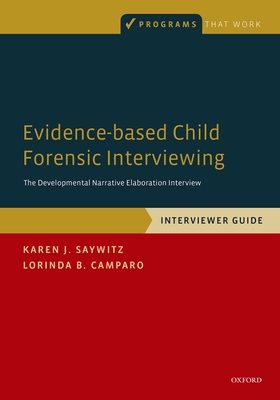
Evidence-based Child Forensic Interviewing addresses this discrepancy and presents an innovative approach to close the gap by providing the scaffolding, structure, and guidance children need to perform optimally. Created by Drs. Karen J. Saywitz and Lorinda B. Camparo and outlined in this guide, the Developmental Narrative Elaboration (DNE) Interview is an evidence-based step-by-step process and set of techniques for forensic contexts designed to help children ages 3-12 accurately tell as much as they can about their experiences and perceptions. The DNE is comprised of a developmentally sensitive core template and optional techniques that can be embedded at the interviewer's discretion as cases unfold. This book reviews the relevant research and then, with sample language, transcripts, and suggested activities, details a three-phased interview with examples. This empirically supported guide is designed to meet the needs of both novice and seasoned professionals in mental health, social service, law enforcement, and the legal system when children's input is needed for legal and social-service decision making.
Log in to write a review for this book.
No reviews yet. Be the first to share your opinion.
Biography not available.
Biography not available.