McCarthy, John Author
Biography not available.

Browse all ART CRITICISM books
Browse all Ashworth books
Browse all BUSINESS AND ECONOMICS books
Browse all FOLKLORE books
Browse all GARDENS books
Browse all GRAPHIC NOVELS books
Browse all HISTORY - MEDIEVAL books
Browse all HUMOUR books
Browse all Juvenile Fiction : Biographical - Other books
Browse all Juvenile Fiction : Historical - Other books
Browse all Juvenile Fiction : Legends, Myths, & Fables - Other books
Browse all Juvenile Fiction : People & Places - Other books
Browse all Juvenile Fiction : People & Places - United States - Other books
Browse all Juvenile Fiction : Religious - Other books
Browse all Juvenile Nonfiction : History - Other books
Browse all Juvenile Nonfiction : Mathematics - Advanced books
Browse all Juvenile Nonfiction : People & Places - Other books
Browse all Juvenile Nonfiction : People & Places - United States - Othe books
Browse all KINDRED books
Browse all LITERARY STUDIES books
Browse all LONDON books
Browse all Lozada books
Browse all Medical : Nursing - Mental Health books
Browse all MIND books
Browse all MUSEOLOGY books
Browse all NON-CLASSIFIABLE books
Browse all NONLINEAR SCIENCE books
Browse all POPULAR SCIENCE books
Browse all RELIGIOUS STUDIES books
Browse all SPIRIT books
Browse all SPORT books
Browse all TRAVEL WRITING books
 Out of Stock
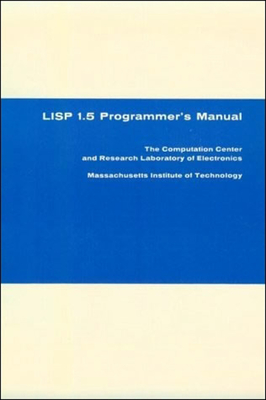
LISP 15 PROGRAMMERS MANUAL
Paperback · ISBN 9780262130110
Inclusive of GST and other taxes
Arriving at your doorstep in 10-15 days
Our logisitcs team will make sure everyitem is delivered safely
| ISBN | 9780262130110 |
|---|---|
| Subtitle | LISP 15 PROGRAMMERS MANUAL |
| Publisher | MIT Press |
| Publication date | August 1962 |
| Language | English |
| MRP | £23.62 GBP |
| Page count | 112 |
| Item weight | 45 g |
The LISP language is designed primarily for symbolic data processing used for symbolic calculations in differential and integral calculus, electrical circuit theory, mathematical logic, game playing, and other fields of artificial intelligence. The manual describes LISP, a formal mathematical language. LISP differs from most programming languages in three important ways. The first way is in the nature of the data. In the LISP language, all data are in the form of symbolic expressions usually referred to as S-expressions, of indefinite length, and which have a branching tree-type of structure, so that significant subexpressions can be readily isolated. In the LISP system, the bulk of the available memory is used for storing S-expressions in the form of list structures. The second distinction is that the LISP language is the source language itself which specifies in what way the S-expressions are to be processed. Third, LISP can interpret and execute programs written in the form of S-expressions. Thus, like machine language, and unlike most other high level languages, it can be used to generate programs for further executions.
Log in to write a review for this book.
No reviews yet. Be the first to share your opinion.
Biography not available.
Biography not available.
Biography not available.