Adorno, Theodor W. Author
Biography not available.

Browse all ART CRITICISM books
Browse all Ashworth books
Browse all FOLKLORE books
Browse all GARDENS books
Browse all GRAPHIC NOVELS books
Browse all Hamilton books
Browse all HISTORY - MEDIEVAL books
Browse all HUMOUR books
Browse all KINDRED books
Browse all LITERARY STUDIES books
Browse all LONDON books
Browse all Lozada books
Browse all Medical : Nursing - Mental Health books
Browse all MIND books
Browse all MUSEOLOGY books
Browse all NON-CLASSIFIABLE books
Browse all NONLINEAR SCIENCE books
Browse all Ormonde books
Browse all POPULAR SCIENCE books
Browse all RELIGIOUS STUDIES books
Browse all SPIRIT books
Browse all SPORT books
Browse all TRAVEL WRITING books
 Out of Stock
Paperback · ISBN 9780262510806
Inclusive of GST and other taxes
Arriving at your doorstep in 10-15 days
Our logisitcs team will make sure everyitem is delivered safely
| ISBN | 9780262510806 |
|---|---|
| Publisher | MIT Press |
| Publication date | September 1994 |
| Language | English |
| MRP | £31.49 GBP |
| Page count | 208 |
| Item weight | 49 g |
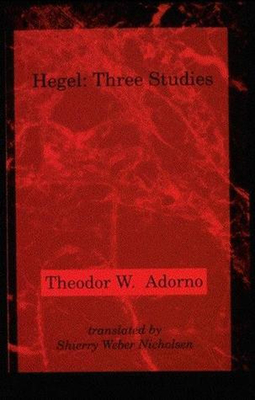
This short masterwork in twentieth-century philosophy provides both a major reinterpretation of Hegel and insight into the evolution of Adorno's critical theory. The first study focuses on the relationship of reason, the individual, and society in Hegel, defending him against the criticism that he was merely an apologist for bourgeois society. The second study examines the experiential content of Hegel's idealism, considering the notion of experience in relation to immediacy, empirical reality, science, and society. The third study, "Skoteinos," is an unusual and fascinating essay in which Adorno lays out his thoughts on understanding Hegel. In his reflections, which spring from his experience teaching at the Goethe University in Frankfurt, questions of textual and philosophical interpretation are intertwined. Rescuing the truth value of Hegel's work is a recurring theme of the critical theory of the Frankfurt School, and nowhere is this goal pursued with more insight than in these three studies. The core problem Adorno sets for himself is how to read Hegel in a way that comprehends both the work and its historical context, thereby allowing conclusions to be drawn that may seem on the surface to be exactly opposed to what Hegel wrote but that are, nevertheless, valid as the present truth of the work. It is the elaboration of this method of interpretation, a negative dialectic, that was Adorno's underlying goal. Adorno's efforts to salvage the contemporaneity of Hegel's thought form part of his response to the increasingly tight net of social control in the aftermath of World War II. In this, his work is related to the very different attempts to undermine reified thinking undertaken by the various French theorists. The continued development of what Adorno called "the administered world" has only increased the relevance of his efforts.
Log in to write a review for this book.
No reviews yet. Be the first to share your opinion.
Biography not available.
Biography not available.