de Souza, Clarisse Sieckenius Author
Biography not available.

Browse all FOLKLORE books
Browse all GARDENS books
Browse all GRAPHIC NOVELS books
Browse all HISTORY - MEDIEVAL books
Browse all HUMOUR books
Browse all Juvenile Fiction : Biographical - Other books
Browse all Juvenile Fiction : Historical - Other books
Browse all Juvenile Fiction : Legends, Myths, & Fables - Other books
Browse all Juvenile Fiction : People & Places - Other books
Browse all Juvenile Fiction : People & Places - United States - Other books
Browse all Juvenile Fiction : Religious - Other books
Browse all Juvenile Nonfiction : History - Other books
Browse all Juvenile Nonfiction : Mathematics - Advanced books
Browse all Juvenile Nonfiction : People & Places - Other books
Browse all Juvenile Nonfiction : People & Places - United States - Othe books
Browse all LITERARY STUDIES books
Browse all LONDON books
Browse all Medical : Nursing - Mental Health books
Browse all MIND books
Browse all MUSEOLOGY books
Browse all NON-CLASSIFIABLE books
Browse all NONLINEAR SCIENCE books
Browse all POPULAR SCIENCE books
Browse all RELIGIOUS STUDIES books
Browse all SPIRIT books
Browse all SPORT books
Browse all TRAVEL WRITING books
 Out of Stock
Paperback · ISBN 9780262527095
Inclusive of GST and other taxes
Arriving at your doorstep in 10-15 days
Our logisitcs team will make sure everyitem is delivered safely
| ISBN | 9780262527095 |
|---|---|
| Publisher | MIT Press |
| Publication date | February 2005 |
| Language | English |
| MRP | £36.98 GBP |
| Page count | 308 |
| Item weight | 107 g |
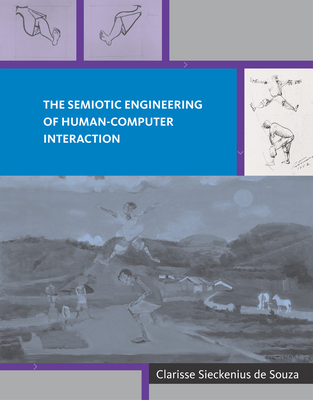
In The Semiotic Engineering of Human-Computer Interaction, Clarisse Sieckenius de Souza proposes an account of HCI that draws on concepts from semiotics and computer science to investigate the relationship between user and designer. Semiotics is the study of signs, and the essence of semiotic engineering is the communication between designers and users at interaction time; designers must somehow be present in the interface to tell users how to use the signs that make up a system or program. This approach, which builds on--but goes further than--the currently dominant user-centered approach, allows designers to communicate their overall vision and therefore helps users understand designs--rather than simply which icon to click.
According to de Souza's account, both designers and users are interlocutors in an overall communication process that takes place through an interface of words, graphics, and behavior. Designers must tell users what they mean by the artifact they have created, and users must understand and respond to what they are being told. By coupling semiotic theory and engineering, de Souza's approach to HCI design encompasses the principles, the materials, the processes, and the possibilities for producing meaningful interactive computer system discourse and achieves a broader perspective than cognitive, ethnographic, or ergonomic approaches.
De Souza begins with a theoretical overview and detailed exposition of the semiotic engineering account of HCI. She then shows how this approach can be applied specifically to HCI evaluation and design of online help systems, customization and end-user programming, and multiuser applications. Finally, she reflects on the potential and opportunities for research in semiotic engineering.
Log in to write a review for this book.
No reviews yet. Be the first to share your opinion.
Biography not available.