O'Reilly, Randall C. Author
Biography not available.

Browse all ART CRITICISM books
Browse all Ashworth books
Browse all FOLKLORE books
Browse all GARDENS books
Browse all GRAPHIC NOVELS books
Browse all Hamilton books
Browse all HISTORY - MEDIEVAL books
Browse all HUMOUR books
Browse all KINDRED books
Browse all LITERARY STUDIES books
Browse all LONDON books
Browse all Lozada books
Browse all Medical : Nursing - Mental Health books
Browse all MIND books
Browse all MUSEOLOGY books
Browse all NON-CLASSIFIABLE books
Browse all NONLINEAR SCIENCE books
Browse all Ormonde books
Browse all POPULAR SCIENCE books
Browse all RELIGIOUS STUDIES books
Browse all SPIRIT books
Browse all SPORT books
Browse all TRAVEL WRITING books
 Out of Stock
Paperback · ISBN 9780262650540
Inclusive of GST and other taxes
Arriving at your doorstep in 10-15 days
Our logisitcs team will make sure everyitem is delivered safely
| ISBN | 9780262650540 |
|---|---|
| Publisher | MIT Press |
| Publication date | August 2000 |
| Language | English |
| MRP | £67.25 GBP |
| Page count | 532 |
| Item weight | 207 g |
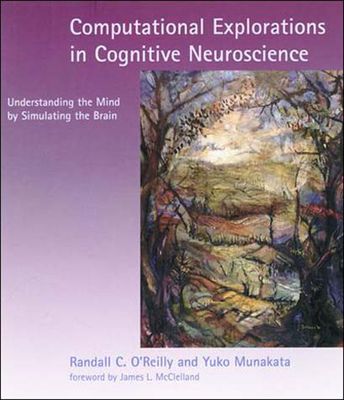
The goal of computational cognitive neuroscience is to understand how the brain embodies the mind by using biologically based computational models comprising networks of neuronlike units. This text, based on a course taught by Randall O'Reilly and Yuko Munakata over the past several years, provides an in-depth introduction to the main ideas in the field. The neural units in the simulations use equations based directly on the ion channels that govern the behavior of real neurons, and the neural networks incorporate anatomical and physiological properties of the neocortex. Thus the text provides the student with knowledge of the basic biology of the brain as well as the computational skills needed to simulate large-scale cognitive phenomena.
The text consists of two parts. The first part covers basic neural computation mechanisms: individual neurons, neural networks, and learning mechanisms. The second part covers large-scale brain area organization and cognitive phenomena: perception and attention, memory, language, and higher-level cognition. The second part is relatively self-contained and can be used separately for mechanistically oriented cognitive neuroscience courses. Integrated throughout the text are more than forty different simulation models, many of them full-scale research-grade models, with friendly interfaces and accompanying exercises. The simulation software (PDP++, available for all major platforms) and simulations can be downloaded free of charge from the Web. Exercise solutions are available, and the text includes full information on the software.
Log in to write a review for this book.
No reviews yet. Be the first to share your opinion.
Biography not available.
Biography not available.
Biography not available.