Demetrius, F. Joseph Author
Biography not available.

Browse all FOLKLORE books
Browse all GARDENS books
Browse all GRAPHIC NOVELS books
Browse all HISTORY - MEDIEVAL books
Browse all HUMOUR books
Browse all Juvenile Fiction : Biographical - Other books
Browse all Juvenile Fiction : Historical - Other books
Browse all Juvenile Fiction : Legends, Myths, & Fables - Other books
Browse all Juvenile Fiction : People & Places - Other books
Browse all Juvenile Fiction : People & Places - United States - Other books
Browse all Juvenile Fiction : Religious - Other books
Browse all Juvenile Nonfiction : History - Other books
Browse all Juvenile Nonfiction : Mathematics - Advanced books
Browse all Juvenile Nonfiction : People & Places - Other books
Browse all Juvenile Nonfiction : People & Places - United States - Othe books
Browse all LITERARY STUDIES books
Browse all LONDON books
Browse all Medical : Nursing - Mental Health books
Browse all MIND books
Browse all MUSEOLOGY books
Browse all NON-CLASSIFIABLE books
Browse all NONLINEAR SCIENCE books
Browse all POPULAR SCIENCE books
Browse all RELIGIOUS STUDIES books
Browse all SPIRIT books
Browse all SPORT books
Browse all TRAVEL WRITING books
 Out of Stock
BRAZILS NATL ALCOHOL PROGRAM
Hardback · ISBN 9780275931834
Inclusive of GST and other taxes
Arriving at your doorstep in 10-15 days
Our logisitcs team will make sure everyitem is delivered safely
| ISBN | 9780275931834 |
|---|---|
| Subtitle | BRAZILS NATL ALCOHOL PROGRAM |
| Publisher | Praeger |
| Publication date | January 1990 |
| Language | English |
| MRP | £60.00 GBP |
| Page count | 198 |
| Item weight | 101 g |
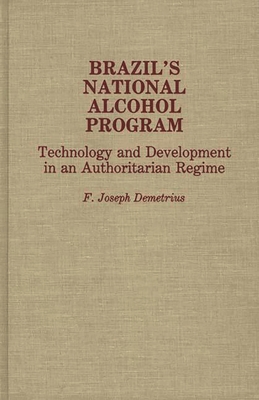
How are political systems likely to shape the choices, uses, and effects of technological progress? This important new book addresses that question in a case study of Brazil's national alcohol program, Proalcool. Proalcool's stated goals are economic growth, and the reduction of personal regional income disparities, through the production of alcohol as a substitute for petroleum fuels used in internal combustion engines. Established by presidential decree in 1975, the program sought to save Brazil's floundering sugar industry and today can be counted as one of the world's largest and most advanced alternative energy experiments. To better understand how Brazil's political system has shaped this technology, the author investigates the program's actual social and economic consequences. He then seeks explanations for these outcomes focusing on the systemic or structural reasons that determined the development of Proalcool's technology. He concludes that the program is best understood as an agent and as a product of an authoritarian political regime, and goes further to analyze its potential role in Brazil's nascent democracy.
The book offers an evaluation of the ways in which the new democratic regime in Brazil is likely to shape the choice, use and development of technologies with the potential for profound and lasting changes on the Brazilian economy. By comparing and contrasting the essential features of a democratic regime with a bureaucratic authoritarian one, the author outlines the ways in which the new Brazilian regime--and other Latin American regimes--are likely to shape their technological choices and the futures of their citizens.
Log in to write a review for this book.
No reviews yet. Be the first to share your opinion.
Biography not available.
Biography not available.