Mingers, John Author
Biography not available.

Browse all FOLKLORE books
Browse all GARDENS books
Browse all GRAPHIC NOVELS books
Browse all HISTORY - MEDIEVAL books
Browse all HUMOUR books
Browse all Juvenile Fiction : Biographical - Other books
Browse all Juvenile Fiction : Historical - Other books
Browse all Juvenile Fiction : Legends, Myths, & Fables - Other books
Browse all Juvenile Fiction : People & Places - Other books
Browse all Juvenile Fiction : People & Places - United States - Other books
Browse all Juvenile Fiction : Religious - Other books
Browse all Juvenile Nonfiction : History - Other books
Browse all Juvenile Nonfiction : Mathematics - Advanced books
Browse all Juvenile Nonfiction : People & Places - Other books
Browse all Juvenile Nonfiction : People & Places - United States - Othe books
Browse all LITERARY STUDIES books
Browse all LONDON books
Browse all Medical : Nursing - Mental Health books
Browse all MIND books
Browse all MUSEOLOGY books
Browse all NON-CLASSIFIABLE books
Browse all NONLINEAR SCIENCE books
Browse all POPULAR SCIENCE books
Browse all RELIGIOUS STUDIES books
Browse all SPIRIT books
Browse all SPORT books
Browse all TRAVEL WRITING books
 Out of Stock
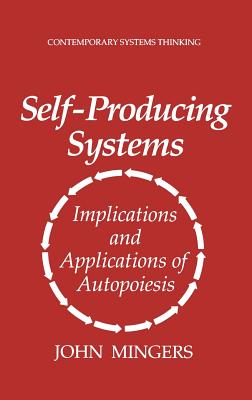
SELF-PRODUCING SYSTEMS 1995/E
Hardback · ISBN 9780306447976
Inclusive of GST and other taxes
Arriving at your doorstep in 10-15 days
Our logisitcs team will make sure everyitem is delivered safely
| ISBN | 9780306447976 |
|---|---|
| Subtitle | SELF-PRODUCING SYSTEMS 1995/E |
| Publisher | Springer |
| Publication date | December 1994 |
| Language | English |
| MRP | £129.99 GBP |
| Page count | 268 |
| Item weight | 122 g |
John Mingers' new volume, Self-Producing Systems: Implications and Ap- plications of Autopoiesis, is a much-needed reference on autopoiesis, a subject penetrating many disciplines today. I can genuinely say that I enjoyed reading the book as it took me stage by stage through a clear and easy-to-grasp understanding of the concepts and ideas of auto- poiesis and then, as the book's title suggests, on through their applica- tions. I found the summary in Chapter 12 particularly useful, helping to crystalize the main points of each chapter. The book conveyed enthusi- asm for the subject and stimulated my interest in it. At times the book is demanding, but only because of the breadth of the subject matter, the terms and concepts associated with its parts, and the challenge of keep- ing hold of all this in the mind at once. This is an exceptional text. ROBERT L. FLOOD Hull, UK Preface In recent years Maturana's and Varela's concept of autopoiesis, origi- nally a biological concept, has made a remarkable impact not just on a single area, but across widely differing disciplines such as sociology, policy science, psychotherapy, cognitive science, and law. Put very briefly, the term autopoiesis connotes the idea that certain types of sys- tems exist in a particular manner-they are self-producing systems. In their operations they continuously produce their own constituents, their own components, which then participate in these same production pro- cesses.
Log in to write a review for this book.
No reviews yet. Be the first to share your opinion.
Biography not available.