Heap, Nicholas Author
Biography not available.

Browse all FOLKLORE books
Browse all GARDENS books
Browse all GRAPHIC NOVELS books
Browse all HISTORY - MEDIEVAL books
Browse all HUMOUR books
Browse all Juvenile Fiction : Biographical - Other books
Browse all Juvenile Fiction : Historical - Other books
Browse all Juvenile Fiction : Legends, Myths, & Fables - Other books
Browse all Juvenile Fiction : People & Places - Other books
Browse all Juvenile Fiction : People & Places - United States - Other books
Browse all Juvenile Fiction : Religious - Other books
Browse all Juvenile Nonfiction : History - Other books
Browse all Juvenile Nonfiction : Mathematics - Advanced books
Browse all Juvenile Nonfiction : People & Places - Other books
Browse all Juvenile Nonfiction : People & Places - United States - Othe books
Browse all LITERARY STUDIES books
Browse all LONDON books
Browse all Medical : Nursing - Mental Health books
Browse all MIND books
Browse all MUSEOLOGY books
Browse all NON-CLASSIFIABLE books
Browse all NONLINEAR SCIENCE books
Browse all POPULAR SCIENCE books
Browse all RELIGIOUS STUDIES books
Browse all SPIRIT books
Browse all SPORT books
Browse all TRAVEL WRITING books
 Out of Stock
INTRODUCTORY DIGITAL ELECTRONI
Paperback · ISBN 9780335101849
Inclusive of GST and other taxes
Arriving at your doorstep in 10-15 days
Our logisitcs team will make sure everyitem is delivered safely
| ISBN | 9780335101849 |
|---|---|
| Subtitle | INTRODUCTORY DIGITAL ELECTRONI |
| Publisher | Springer |
| Publication date | June 1983 |
| Language | English |
| MRP | £44.99 GBP |
| Page count | 196 |
| Item weight | 71 g |
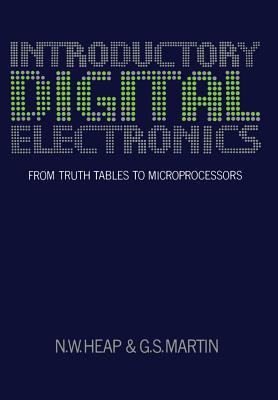
This book is an edited version of part of the teaching text used for the Open University's undergraduate course 'T283 Introductory Electronics', first presented in 1980. The original text was pro- duced by a course team of nine authors and nine support staff. The team was also responsible for student experimental kits, television and radio programmes. The approach adopted by the course team was to try and teach, where possible, through specification of the problem rather than through discussion of the operation of a selection of available devices and components; since this leads more naturally to modem design strategies such as 'top-down'. The emphasis in the book on the solution of combinational and sequential logic problems by the truth tables and ROMs, rather than logic gates and mapping techniques, illustrates this approach. The book covers topics ranging from logic to microprocessor memory systems and is intended for students with a background in analogue electronics who wish to update their knowledge to include digital electronic systems. Chapter 2 introduces the basic ideas of combinational logic design; truth tables, ROMs, logic gates and Boolean algebra. Chapter 3 deals with sequential logic, and shows how one can design binary and decimal counters and use these to produce a system controller. Chapter 4 examines the system elements needed to interconnect analogue and digital systems.
Log in to write a review for this book.
No reviews yet. Be the first to share your opinion.
Biography not available.