Wang, Jihong Author
Biography not available.

Browse all ART CRITICISM books
Browse all Ashworth books
Browse all FOLKLORE books
Browse all GARDENS books
Browse all GRAPHIC NOVELS books
Browse all Hamilton books
Browse all HISTORY - MEDIEVAL books
Browse all HUMOUR books
Browse all Juvenile Fiction : Biographical - Other books
Browse all Juvenile Fiction : Historical - Other books
Browse all Juvenile Fiction : Legends, Myths, & Fables - Other books
Browse all Juvenile Fiction : People & Places - Other books
Browse all Juvenile Fiction : People & Places - United States - Other books
Browse all Juvenile Fiction : Religious - Other books
Browse all Juvenile Nonfiction : History - Other books
Browse all Juvenile Nonfiction : Mathematics - Advanced books
Browse all Juvenile Nonfiction : People & Places - Other books
Browse all Juvenile Nonfiction : People & Places - United States - Othe books
Browse all KINDRED books
Browse all LITERARY STUDIES books
Browse all LONDON books
Browse all Lozada books
Browse all Medical : Nursing - Mental Health books
Browse all MIND books
Browse all MUSEOLOGY books
Browse all NON-CLASSIFIABLE books
Browse all NONLINEAR SCIENCE books
Browse all Ormonde books
Browse all POPULAR SCIENCE books
Browse all RELIGIOUS STUDIES books
Browse all SPIRIT books
Browse all SPORT books
Browse all TRAVEL WRITING books
 Out of Stock
Hardback · ISBN 9780367416997
Inclusive of GST and other taxes
Arriving at your doorstep in 10-15 days
Our logisitcs team will make sure everyitem is delivered safely
| ISBN | 9780367416997 |
|---|---|
| Publisher | Routledge |
| Publication date | May 2021 |
| Language | English |
| MRP | £171.99 GBP |
| Page count | 280 |
| Item weight | 120 g |
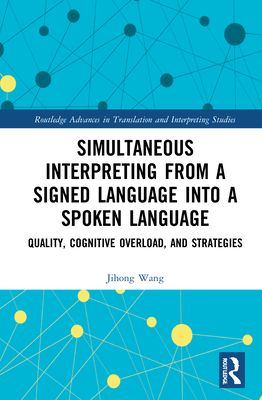
This book examines conference-level simultaneous interpreting from a signed language into a spoken language, drawing on Auslan (Australian Sign Language)-to-English simultaneous interpretation data to explore the skills, knowledge, strategies, and cognitive abilities needed for effective interpretations in this language direction.
As simultaneous interpreting from a spoken language into a signed language is the widely accepted norm within the field of signed language interpreting, to date little has been written on simultaneous interpreting in the other language direction. In an attempt to bridge this gap, Wang conducts microanalysis of an experimental corpus of Auslan-to-English simultaneous interpretations in a mock conference setting to investigate different dimensions of quality assessment, interpreting strategies, cognitive load, and the interpreting process itself. The focus on conference-level simultaneous interpreting not only allows for insights into the impact of signed language variation on the signed-to-spoken language simultaneous interpreting process but also sheds light on the unique demands of conference settings such as the requirement of using a formal register.
Acting as a bridge between spoken language interpreting studies and signed language interpreting studies and highlighting implications for future research on simultaneous interpreting of other language combinations (spoken and signed), this book will be of interest to scholars in translation and interpreting studies as well as active practitioners in these fields.
Log in to write a review for this book.
No reviews yet. Be the first to share your opinion.
Biography not available.