Robinson, Joan Author
Biography not available.

Browse all ART CRITICISM books
Browse all Ashworth books
Browse all FOLKLORE books
Browse all GARDENS books
Browse all GRAPHIC NOVELS books
Browse all Hamilton books
Browse all HISTORY - MEDIEVAL books
Browse all HUMOUR books
Browse all KINDRED books
Browse all LITERARY STUDIES books
Browse all LONDON books
Browse all Lozada books
Browse all Medical : Nursing - Mental Health books
Browse all MIND books
Browse all MUSEOLOGY books
Browse all NON-CLASSIFIABLE books
Browse all NONLINEAR SCIENCE books
Browse all Ormonde books
Browse all POPULAR SCIENCE books
Browse all RELIGIOUS STUDIES books
Browse all SPIRIT books
Browse all SPORT books
Browse all TRAVEL WRITING books
 Out of Stock
Paperback · ISBN 9780367540876
Inclusive of GST and other taxes
Arriving at your doorstep in 10-15 days
Our logisitcs team will make sure everyitem is delivered safely
| ISBN | 9780367540876 |
|---|---|
| Publisher | Routledge |
| Publication date | March 2021 |
| Language | English |
| MRP | £21.99 GBP |
| Page count | 158 |
| Item weight | 42 g |
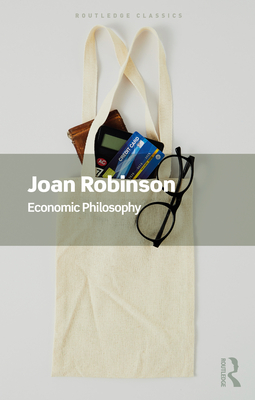
Joan Robinson (1903-1983) was one of the greatest economists of the twentieth century and a fearless critic of free-market capitalism. A major figure in the controversial 'Cambridge School' of economics in the post-war period, she made fundamental contributions to the economics of international trade and development.
In Economic Philosophy Robinson looks behind the curtain of economics to reveal a constant battle between economics as a science and economics as ideology, which she argued was integral to economics. In her customary vivid and pellucid style, she criticizes early economists Adam Smith and David Ricardo, and neo-classical economists Alfred Marshall, Stanley Jevons and Leon Walras, over the question of value. She shows that what they respectively considered to be the generators of value - labour-time, marginal utility or preferences - are not scientific but 'metaphysical', and that it is frequently in ideology, not science, that we find the reason for the rejection of economic theories. She also weighs up the implications of the Keynesian revolution in economics, particularly whether Keynes's theories are applicable to developing economies. Robinson concludes with a prophetic lesson that resonates in today's turbulent and unequal economy: that the task of the economist is to combat the idea that the only values that count are those that can be measured in terms of money.
This Routledge Classics edition includes a new foreword by Sheila Dow.
Log in to write a review for this book.
No reviews yet. Be the first to share your opinion.
Biography not available.