Capra, Fritjof Author
Biography not available.

Browse all FOLKLORE books
Browse all GARDENS books
Browse all GRAPHIC NOVELS books
Browse all HISTORY - MEDIEVAL books
Browse all HUMOUR books
Browse all Juvenile Fiction : Biographical - Other books
Browse all Juvenile Fiction : Historical - Other books
Browse all Juvenile Fiction : Legends, Myths, & Fables - Other books
Browse all Juvenile Fiction : People & Places - Other books
Browse all Juvenile Fiction : People & Places - United States - Other books
Browse all Juvenile Fiction : Religious - Other books
Browse all Juvenile Nonfiction : History - Other books
Browse all Juvenile Nonfiction : Mathematics - Advanced books
Browse all Juvenile Nonfiction : People & Places - Other books
Browse all Juvenile Nonfiction : People & Places - United States - Othe books
Browse all LITERARY STUDIES books
Browse all LONDON books
Browse all Medical : Nursing - Mental Health books
Browse all MIND books
Browse all MUSEOLOGY books
Browse all NON-CLASSIFIABLE books
Browse all NONLINEAR SCIENCE books
Browse all POPULAR SCIENCE books
Browse all RELIGIOUS STUDIES books
Browse all SPIRIT books
Browse all SPORT books
Browse all TRAVEL WRITING books
 Out of Stock
Paperback · ISBN 9780369371997
Inclusive of GST and other taxes
Arriving at your doorstep in 10-15 days
Our logisitcs team will make sure everyitem is delivered safely
| ISBN | 9780369371997 |
|---|---|
| Publisher | ReadHowYouWant |
| Publication date | November 2013 |
| Language | English |
| MRP | £34.99 GBP |
| Page count | 862 |
| Item weight | 236 g |
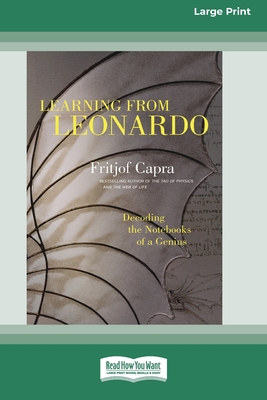
Leonardo da Vinci was a brilliant artist, scientist, engineer, mathematician, architect, inventor, and even musician - the archetypal Renaissance man. But he was also a profoundly modern man. Not only did Leonardo invent the empirical scientific method over a century before Galileo and Francis Bacon, but Capra's decade - long study of Leonardo's fabled notebooks reveals that he was a systems thinker centuries before the term was coined. At the very core of Leonardo's science, Capra argues, lies his persistent quest for understanding the nature of life. His science is a science of living forms, of qualities and patterns, radically different from the mechanistic science that emerged 200 years later. Because he saw the world as an integrated whole, Leonardo always applied concepts from one area to illuminate problems in another. His studies of the movement of water informed his ideas about how landscapes are shaped, how sap rises in plants, how air moves over a bird's wing, and how blood flows in the human body. His observations of nature enhanced his art, his drawings were integral to his scientific studies, and he brought art, science, and technology together in his beautiful and elegant mechanical and architectural designs. Capra describes seven defining characteristics of Leonardo da Vinci's genius and includes a list of over forty discoveries he made that weren't rediscovered until centuries later. Capra follows the organizational scheme Leonardo himself intended to use if he ever published his notebooks. So in a sense, this is Leonardo's science as he himself would have presented it. Obviously, we can't all be geniuses on the scale of Leonardo da Vinci. But his persistent endeavor to put life at the very center of his art, science, and design and his recognition that all natural phenomena are fundamentally interconnected and interdependent are important lessons we can learn from. By exploring the mind of the preeminent Renaissance genius, we can gain profound insights into how to address the complex challenges of the 21st century.
Log in to write a review for this book.
No reviews yet. Be the first to share your opinion.
Biography not available.