Singh, David J. Author
Biography not available.

Browse all ART CRITICISM books
Browse all Ashworth books
Browse all FOLKLORE books
Browse all GARDENS books
Browse all GRAPHIC NOVELS books
Browse all Hamilton books
Browse all HISTORY - MEDIEVAL books
Browse all HUMOUR books
Browse all Juvenile Fiction : Biographical - Other books
Browse all Juvenile Fiction : Historical - Other books
Browse all Juvenile Fiction : Legends, Myths, & Fables - Other books
Browse all Juvenile Fiction : People & Places - Other books
Browse all Juvenile Fiction : People & Places - United States - Other books
Browse all Juvenile Fiction : Religious - Other books
Browse all Juvenile Nonfiction : History - Other books
Browse all Juvenile Nonfiction : Mathematics - Advanced books
Browse all Juvenile Nonfiction : People & Places - Other books
Browse all Juvenile Nonfiction : People & Places - United States - Othe books
Browse all KINDRED books
Browse all LITERARY STUDIES books
Browse all LONDON books
Browse all Lozada books
Browse all Medical : Nursing - Mental Health books
Browse all MIND books
Browse all MUSEOLOGY books
Browse all NON-CLASSIFIABLE books
Browse all NONLINEAR SCIENCE books
Browse all Ormonde books
Browse all POPULAR SCIENCE books
Browse all RELIGIOUS STUDIES books
Browse all SPIRIT books
Browse all SPORT books
Browse all TRAVEL WRITING books
 Out of Stock
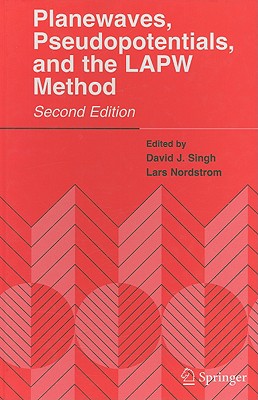
PLANEWAVES PSEUDOPOTENTIALS-2E
Hardback · ISBN 9780387287805
Inclusive of GST and other taxes
Arriving at your doorstep in 10-15 days
Our logisitcs team will make sure everyitem is delivered safely
| ISBN | 9780387287805 |
|---|---|
| Subtitle | PLANEWAVES PSEUDOPOTENTIALS-2E |
| Publisher | Springer |
| Publication date | November 2005 |
| Language | English |
| MRP | £119.99 GBP |
| Page count | 154 |
| Item weight | 88 g |
The first edition of this book, published in 1994, provided an exposition of the LAPW method and its relationship with other electronic structure approaches, especially Car-Parrinello based planewave methods. Since publication of that book, the LAPW method has been transformed from a specialized method used mostly by researchers running their own home made versions, to a popular, widely used method, where most users run standard codes to investigate ma- terials of interest to them. This is an exciting development because it opens the door to widespread use of first principles calculations in diverse areas of condensed matter physics and materials science. The positive impact of this on scientific progress is already becoming clear. Also as a result of this trend, the great majority of researchers using the LAPW method are no longer directly in- volved in the development of LAPW codes. Nonetheless, it remains important to understand how the LAPW method works, what its limitations are, and how its parameters determine the quahty and efficiency of calculations. The scientist with an understanding of how the method works has a clear advantage. This edition is an updated and expanded treatment of the LAPW method, including descriptions of key developments in the LAPW method since 1994, such as p 1/2 local orbitals, the APW-i-LO method, LDA+U calculations and non-collinear magnetism, as well as much of the material from the first edition.
Log in to write a review for this book.
No reviews yet. Be the first to share your opinion.
Biography not available.
Biography not available.