Sellnow, Timothy L. Author
Biography not available.

Browse all ART CRITICISM books
Browse all Ashworth books
Browse all FOLKLORE books
Browse all GARDENS books
Browse all GRAPHIC NOVELS books
Browse all Hamilton books
Browse all HISTORY - MEDIEVAL books
Browse all HUMOUR books
Browse all Juvenile Fiction : Biographical - Other books
Browse all Juvenile Fiction : Historical - Other books
Browse all Juvenile Fiction : Legends, Myths, & Fables - Other books
Browse all Juvenile Fiction : People & Places - Other books
Browse all Juvenile Fiction : People & Places - United States - Other books
Browse all Juvenile Fiction : Religious - Other books
Browse all Juvenile Nonfiction : History - Other books
Browse all Juvenile Nonfiction : Mathematics - Advanced books
Browse all Juvenile Nonfiction : People & Places - Other books
Browse all Juvenile Nonfiction : People & Places - United States - Othe books
Browse all KINDRED books
Browse all LITERARY STUDIES books
Browse all LONDON books
Browse all Lozada books
Browse all Medical : Nursing - Mental Health books
Browse all MIND books
Browse all MUSEOLOGY books
Browse all NON-CLASSIFIABLE books
Browse all NONLINEAR SCIENCE books
Browse all Ormonde books
Browse all POPULAR SCIENCE books
Browse all RELIGIOUS STUDIES books
Browse all SPIRIT books
Browse all SPORT books
Browse all TRAVEL WRITING books
 Out of Stock
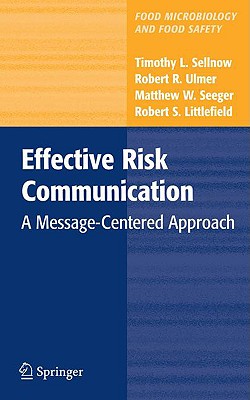
EFFECTIVE RISK COMMUNICATION
Hardback · ISBN 9780387797267
Inclusive of GST and other taxes
Arriving at your doorstep in 10-15 days
Our logisitcs team will make sure everyitem is delivered safely
| ISBN | 9780387797267 |
|---|---|
| Subtitle | EFFECTIVE RISK COMMUNICATION |
| Publisher | Springer |
| Publication date | November 2008 |
| Language | English |
| MRP | £89.99 GBP |
| Page count | 200 |
| Item weight | 101 g |
Coordination of risk assessments and risk communication strategies requires information sharing and establishing networks of working relationships between groups and agencies. Establishing these relationships necessitates overcoming - stitutional, cultural, and political boundaries. Signi?cant barriers exist between r- ulatory agencies and industry groups. Traditionally, these groups have mistrusted one another, and cooperation and collaboration, including sharing information, c- respondingly has been limited. The adoption of radio frequency identi?cation te- nology for tracking livestock, for example, has been met with signi?cant resistance due in part to mistrust between regulatory agencies and producers (Veil, 2006). In the food industry, the need for coordination has been enhanced by industry in- gration and globalization of both markets and production. In the case of GM foods discussed earlier, disagreements between U. S., European Union, and Canadian r- ulatory agencies fueled the debate over the safety of GM crops. Overcoming institutional and cultural barriers, and mistrust is necessary to create consistency in risk messages. Open communication and information sharing can help clarify where risk perceptions diverge and identify points of convergence. The outcome may not be universal agreement about risks, but convergence around the general parameters of risk. Summary These best practice strategies of risk communication are not designed to function as distinct steps or isolated approaches. Rather than being mutually exclusive, they serve to complement one another and create a coherent approach to confronting risk communication problems.
Log in to write a review for this book.
No reviews yet. Be the first to share your opinion.
Biography not available.
Biography not available.
Biography not available.