Golubitsky, M. Author
Biography not available.

Browse all ART CRITICISM books
Browse all Ashworth books
Browse all FOLKLORE books
Browse all GARDENS books
Browse all GRAPHIC NOVELS books
Browse all Hamilton books
Browse all HISTORY - MEDIEVAL books
Browse all HUMOUR books
Browse all KINDRED books
Browse all LITERARY STUDIES books
Browse all LONDON books
Browse all Lozada books
Browse all Medical : Nursing - Mental Health books
Browse all MIND books
Browse all MUSEOLOGY books
Browse all NON-CLASSIFIABLE books
Browse all NONLINEAR SCIENCE books
Browse all Ormonde books
Browse all POPULAR SCIENCE books
Browse all RELIGIOUS STUDIES books
Browse all SPIRIT books
Browse all SPORT books
Browse all TRAVEL WRITING books
 Out of Stock
STABLE MAPPINGS & THEIR SINGUL
Paperback · ISBN 9780387900735
Inclusive of GST and other taxes
Arriving at your doorstep in 10-15 days
Our logisitcs team will make sure everyitem is delivered safely
| ISBN | 9780387900735 |
|---|---|
| Subtitle | STABLE MAPPINGS & THEIR SINGUL |
| Publisher | Springer |
| Publication date | March 1974 |
| Language | English |
| MRP | £74.99 GBP |
| Page count | 224 |
| Item weight | 68 g |
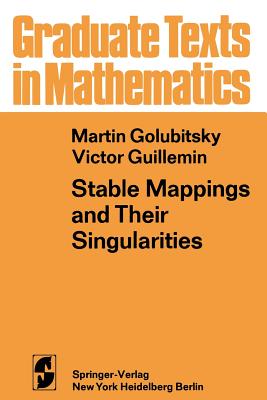
This book aims to present to first and second year graduate students a beautiful and relatively accessible field of mathematics-the theory of singu- larities of stable differentiable mappings. The study of stable singularities is based on the now classical theories of Hassler Whitney, who determined the generic singularities (or lack of them) of Rn Rm (m 2n - 1) and R2 R2, and Marston Morse, for mappings who studied these singularities for Rn R. It was Rene Thorn who noticed (in the late '50's) that all of these results could be incorporated into one theory. The 1960 Bonn notes of Thom and Harold Levine (reprinted in [42]) gave the first general exposition of this theory. However, these notes preceded the work of Bernard Malgrange [23] on what is now known as the Malgrange Preparation Theorem-which allows the relatively easy computation of normal forms of stable singularities as well as the proof of the main theorem in the subject-and the definitive work of John Mather. More recently, two survey articles have appeared, by Arnold [4] and Wall [53], which have done much to codify the new material; still there is no totally accessible description of this subject for the beginning student. We hope that these notes will partially fill this gap. In writing this manuscript, we have repeatedly cribbed from the sources mentioned above-in particular, the Thom-Levine notes and the six basic papers by Mather.
Log in to write a review for this book.
No reviews yet. Be the first to share your opinion.
Biography not available.
Biography not available.
Biography not available.