Aoki, Masanao Editor
Biography not available.

Browse all FOLKLORE books
Browse all GARDENS books
Browse all GRAPHIC NOVELS books
Browse all HISTORY - MEDIEVAL books
Browse all HUMOUR books
Browse all Juvenile Fiction : Biographical - Other books
Browse all Juvenile Fiction : Historical - Other books
Browse all Juvenile Fiction : Legends, Myths, & Fables - Other books
Browse all Juvenile Fiction : People & Places - Other books
Browse all Juvenile Fiction : People & Places - United States - Other books
Browse all Juvenile Fiction : Religious - Other books
Browse all Juvenile Nonfiction : History - Other books
Browse all Juvenile Nonfiction : Mathematics - Advanced books
Browse all Juvenile Nonfiction : People & Places - Other books
Browse all Juvenile Nonfiction : People & Places - United States - Othe books
Browse all LITERARY STUDIES books
Browse all LONDON books
Browse all Medical : Nursing - Mental Health books
Browse all MIND books
Browse all MUSEOLOGY books
Browse all NON-CLASSIFIABLE books
Browse all NONLINEAR SCIENCE books
Browse all POPULAR SCIENCE books
Browse all RELIGIOUS STUDIES books
Browse all SPIRIT books
Browse all SPORT books
Browse all TRAVEL WRITING books
 Out of Stock
APPLICATIONS OF COMPUTER AIDED
Paperback · ISBN 9780387947518
Inclusive of GST and other taxes
Arriving at your doorstep in 10-15 days
Our logisitcs team will make sure everyitem is delivered safely
| ISBN | 9780387947518 |
|---|---|
| Subtitle | APPLICATIONS OF COMPUTER AIDED |
| Publisher | Springer |
| Publication date | December 1996 |
| Language | English |
| MRP | £89.99 GBP |
| Page count | 352 |
| Item weight | 109 g |
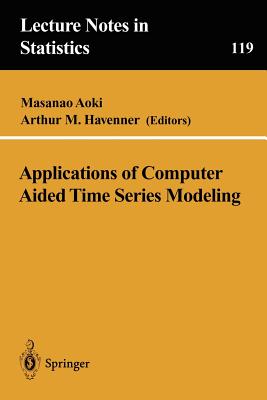
This book consists of three parts: Part One is composed of two introductory chapters. The first chapter provides an instrumental varible interpretation of the state space time series algorithm originally proposed by Aoki (1983), and gives an introductory account for incorporating exogenous signals in state space models. The second chapter, by Havenner, gives practical guidance in apply- ing this algorithm by one of the most experienced practitioners of the method. Havenner begins by summarizing six reasons state space methods are advanta- geous, and then walks the reader through construction and evaluation of a state space model for four monthly macroeconomic series: industrial production in- dex, consumer price index, six month commercial paper rate, and money stock (Ml). To single out one of the several important insights in modeling that he shares with the reader, he discusses in Section 2ii the effects of sampling er- rors and model misspecification on successful modeling efforts. He argues that model misspecification is an important amplifier of the effects of sampling error that may cause symplectic matrices to have complex unit roots, a theoretical impossibility. Correct model specifications increase efficiency of estimators and often eliminate this finite sample problem. This is an important insight into the positive realness of covariance matrices; positivity has been emphasized by system engineers to the exclusion of other methods of reducing sampling error and alleviating what is simply a finite sample problem. The second and third parts collect papers that describe specific applications.
Log in to write a review for this book.
No reviews yet. Be the first to share your opinion.
Biography not available.
Biography not available.