Wonham, W.M. Author
Biography not available.

Browse all ART CRITICISM books
Browse all Ashworth books
Browse all FOLKLORE books
Browse all GARDENS books
Browse all GRAPHIC NOVELS books
Browse all Hamilton books
Browse all HISTORY - MEDIEVAL books
Browse all HUMOUR books
Browse all KINDRED books
Browse all LITERARY STUDIES books
Browse all LONDON books
Browse all Lozada books
Browse all Medical : Nursing - Mental Health books
Browse all MIND books
Browse all MUSEOLOGY books
Browse all NON-CLASSIFIABLE books
Browse all NONLINEAR SCIENCE books
Browse all Ormonde books
Browse all POPULAR SCIENCE books
Browse all RELIGIOUS STUDIES books
Browse all SPIRIT books
Browse all SPORT books
Browse all TRAVEL WRITING books
 Out of Stock
LINEAR MULTIVARIABLE CONTROL 1
Hardback · ISBN 9780387960715
Inclusive of GST and other taxes
Arriving at your doorstep in 10-15 days
Our logisitcs team will make sure everyitem is delivered safely
| ISBN | 9780387960715 |
|---|---|
| Subtitle | LINEAR MULTIVARIABLE CONTROL 1 |
| Publisher | Springer |
| Publication date | December 1985 |
| Language | English |
| MRP | £149.99 GBP |
| Page count | 352 |
| Item weight | 148 g |
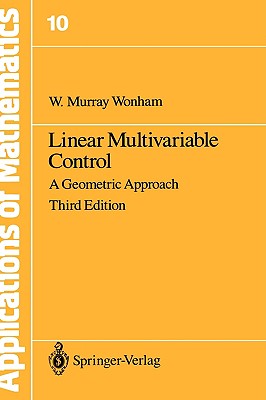
In wntmg this monograph my aim has been to present a "geometric" approach to the structural synthesis of multivariable control systems that are linear, time-invariant and of finite dynamic order. The book is ad- dressed to graduate students specializing in control, to engineering scientists involved in control systems research and development, and to mathemati- cians interested in systems control theory. The label "geometric" in the title is applied for several reasons. First and obviously, the setting is linear state space and the mathematics chiefly linear algebra in abstract (geometric) style. The basic ideas are the familiar system concepts of controllability and observability, thought of as geometric prop- erties of distinguished state subspaces. Indeed, the geometry was first brought in out of revulsion against the orgy of matrix manipulation which linear control theory mainly consisted of, around fifteen years ago. But secondly and of greater interest, the geometric setting rather quickly sug- gested new methods of attacking synthesis which have proved to be intuitive and economical; they are also easily reduced to matrix arithmetic as soon as you want to compute. The essence of the "geometric" approach is just this: instead of looking directly for a feedback law (say u = Fx) which would solve your synthesis problem if a solution exists, first characterize solvability as a verifiable property of some constructible state subspace, say Y. Then, if all is well, you may calculate F from Y quite easily.
Log in to write a review for this book.
No reviews yet. Be the first to share your opinion.
Biography not available.