Netessine, Serguei Editor
Biography not available.

Browse all ART CRITICISM books
Browse all Ashworth books
Browse all FOLKLORE books
Browse all GARDENS books
Browse all GRAPHIC NOVELS books
Browse all Hamilton books
Browse all HISTORY - MEDIEVAL books
Browse all HUMOUR books
Browse all KINDRED books
Browse all LITERARY STUDIES books
Browse all LONDON books
Browse all Lozada books
Browse all Medical : Nursing - Mental Health books
Browse all MIND books
Browse all MUSEOLOGY books
Browse all NON-CLASSIFIABLE books
Browse all NONLINEAR SCIENCE books
Browse all Ormonde books
Browse all POPULAR SCIENCE books
Browse all RELIGIOUS STUDIES books
Browse all SPIRIT books
Browse all SPORT books
Browse all TRAVEL WRITING books
 Out of Stock
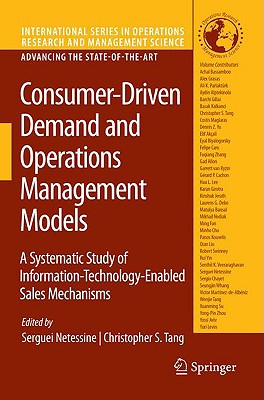
CONSUMER DRIVEN DEMAND & OPERA
Hardback · ISBN 9780387980188
Inclusive of GST and other taxes
Arriving at your doorstep in 10-15 days
Our logisitcs team will make sure everyitem is delivered safely
| ISBN | 9780387980188 |
|---|---|
| Subtitle | CONSUMER DRIVEN DEMAND & OPERA |
| Publisher | Springer |
| Publication date | June 2009 |
| Language | English |
| MRP | £159.99 GBP |
| Page count | 514 |
| Item weight | 197 g |
To compete in today's volatile market with rapidly changing consumer tastes and erce competition, companies in the manufacturing and service industries are - ploying new mechanisms to increase sales, market shares, and pro ts. As an - fective mechanism to segment a market comprising of consumers with different needs, preferences, and willingness-to-pay, many rms have used product (or s- vice) variety with different price points to serve different segments of the market, see Ho (1998). Ideally, the price of each of these products (or services) targets a particular segment of customers. For example, airlines often use different terms of sales (refundable/non-refundable, upgradable/non-upgradable, direct/connecting ight, etc. ) to sell economy class tickets at different prices. Likewise, retailers - ten sell the same product at different prices in different channels (company's own web site, dealers' web sites, or company's physical stores) or at different times (- fore, during, and after the selling season), see Talluri and van Ryzin (2005). Ample academic literature in Operations Management and other areas considered these strategies. However, as consumers become more knowledgeable about the product, pricing, organizational and operational policies that the companies deploy for pr- ucts and services, their purchasing begins to change dramatically. In the academic Operations Management literature, consumer demand is often assumedtobe exogenous so that demand functions are usually modeled as well de- ned and exogenously speci ed functions of price and/or other product attributes such as quality.
Log in to write a review for this book.
No reviews yet. Be the first to share your opinion.
Biography not available.
Biography not available.