Floud, Roderick Author
Biography not available.

Browse all FOLKLORE books
Browse all GARDENS books
Browse all GRAPHIC NOVELS books
Browse all HISTORY - MEDIEVAL books
Browse all HUMOUR books
Browse all Juvenile Fiction : Biographical - Other books
Browse all Juvenile Fiction : Historical - Other books
Browse all Juvenile Fiction : Legends, Myths, & Fables - Other books
Browse all Juvenile Fiction : People & Places - Other books
Browse all Juvenile Fiction : People & Places - United States - Other books
Browse all Juvenile Fiction : Religious - Other books
Browse all Juvenile Nonfiction : History - Other books
Browse all Juvenile Nonfiction : Mathematics - Advanced books
Browse all Juvenile Nonfiction : People & Places - Other books
Browse all Juvenile Nonfiction : People & Places - United States - Othe books
Browse all LITERARY STUDIES books
Browse all LONDON books
Browse all Medical : Nursing - Mental Health books
Browse all MIND books
Browse all MUSEOLOGY books
Browse all NON-CLASSIFIABLE books
Browse all NONLINEAR SCIENCE books
Browse all POPULAR SCIENCE books
Browse all RELIGIOUS STUDIES books
Browse all SPIRIT books
Browse all SPORT books
Browse all TRAVEL WRITING books
 Out of Stock
Paperback · ISBN 9780415607599
Inclusive of GST and other taxes
Arriving at your doorstep in 10-15 days
Our logisitcs team will make sure everyitem is delivered safely
| ISBN | 9780415607599 |
|---|---|
| Publisher | Routledge |
| Publication date | October 2010 |
| Language | English |
| MRP | £50.99 GBP |
| Page count | 238 |
| Item weight | 75 g |
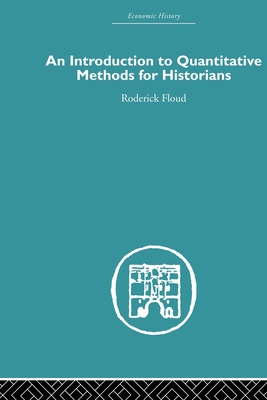
Many statements made by historians are quantitative statements, involving the use of measurable historical evidence. The historian who uses quantitative methods to analyse and interpret such information needs to be well acquainted with the particular methods and techniques of analysis and to be able to make the best use of the data that are available. There is an increasing need for training in such methods and in the interpretation of the large volume of literature now using quantitative techniques. Dr Floud's text, which is relevant to all branches of historical inquiry, provides a straightforward and intelligible introduction for all students and research workers.
The simpler and more useful techniques of descriptive and analytical statistics are described, up to the level of simple linear regression. Historical examples are used throughout, and great attention is paid to the need to ensure that the techniques are consistent with the quality of the data and with the historical problems they are intended to solve. Attention is paid to problems of the analysis of time series, which are of particular use to historians. No previous knowledge of statistics is assumed, and the simple mathematical techniques that are used are fully and clearly explained, without the use of more mathematical knowledge than is provided by an O-level course. A bibliography is provided to guide historians towards the most useful further reading. This student friendly text was first published in 1973.
Log in to write a review for this book.
No reviews yet. Be the first to share your opinion.
Biography not available.