Gupta, S. C. Author
Biography not available.

Browse all ART CRITICISM books
Browse all Ashworth books
Browse all BUSINESS AND ECONOMICS books
Browse all FOLKLORE books
Browse all GARDENS books
Browse all GRAPHIC NOVELS books
Browse all HISTORY - MEDIEVAL books
Browse all HUMOUR books
Browse all Juvenile Fiction : Biographical - Other books
Browse all Juvenile Fiction : Historical - Other books
Browse all Juvenile Fiction : Legends, Myths, & Fables - Other books
Browse all Juvenile Fiction : People & Places - Other books
Browse all Juvenile Fiction : People & Places - United States - Other books
Browse all Juvenile Fiction : Religious - Other books
Browse all Juvenile Nonfiction : History - Other books
Browse all Juvenile Nonfiction : Mathematics - Advanced books
Browse all Juvenile Nonfiction : People & Places - Other books
Browse all Juvenile Nonfiction : People & Places - United States - Othe books
Browse all KINDRED books
Browse all LITERARY STUDIES books
Browse all LONDON books
Browse all Lozada books
Browse all Medical : Nursing - Mental Health books
Browse all MIND books
Browse all MUSEOLOGY books
Browse all NON-CLASSIFIABLE books
Browse all NONLINEAR SCIENCE books
Browse all POPULAR SCIENCE books
Browse all RELIGIOUS STUDIES books
Browse all SPIRIT books
Browse all SPORT books
Browse all TRAVEL WRITING books
 Out of Stock
CLASSICAL STEFAN PROBLEM
Hardback · ISBN 9780444510860
Inclusive of GST and other taxes
Arriving at your doorstep in 10-15 days
Our logisitcs team will make sure everyitem is delivered safely
| ISBN | 9780444510860 |
|---|---|
| Subtitle | CLASSICAL STEFAN PROBLEM |
| Publisher | Jai Press |
| Publication date | October 2003 |
| Language | English |
| MRP | £90.00 GBP |
| Page count | 404 |
| Item weight | 156 g |
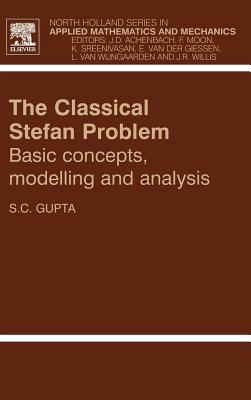
This volume emphasises studies related to classical Stefan problems. The term "Stefan problem" is generally used for heat transfer problems with phase-changes such as from the liquid to the solid. Stefan problems have some characteristics that are typical of them, but certain problems arising in fields such as mathematical physics and engineering also exhibit characteristics similar to them. The term classical" distinguishes the formulation of these problems from their weak formulation, in which the solution need not possess classical derivatives. Under suitable assumptions, a weak solution could be as good as a classical solution. In hyperbolic Stefan problems, the characteristic features of Stefan problems are present but unlike in Stefan problems, discontinuous solutions are allowed because of the hyperbolic nature of the heat equation. The numerical solutions of inverse Stefan problems, and the analysis of direct Stefan problems are so integrated that it is difficult to discuss one without referring to the other. So no strict line of demarcation can be identified between a classical Stefan problem and other similar problems. On the other hand, including every related problem in the domain of classical Stefan problem would require several volumes for their description. A suitable compromise has to be made. The basic concepts, modelling, and analysis of the classical Stefan problems have been extensively investigated and there seems to be a need to report the results at one place. This book attempts to answer that need.
Log in to write a review for this book.
No reviews yet. Be the first to share your opinion.
Biography not available.