Valiant, Leslie Author
Biography not available.

Browse all ART CRITICISM books
Browse all Ashworth books
Browse all FOLKLORE books
Browse all GARDENS books
Browse all GRAPHIC NOVELS books
Browse all Hamilton books
Browse all HISTORY - MEDIEVAL books
Browse all HUMOUR books
Browse all KINDRED books
Browse all LITERARY STUDIES books
Browse all LONDON books
Browse all Lozada books
Browse all Medical : Nursing - Mental Health books
Browse all MIND books
Browse all MUSEOLOGY books
Browse all NON-CLASSIFIABLE books
Browse all NONLINEAR SCIENCE books
Browse all Ormonde books
Browse all POPULAR SCIENCE books
Browse all RELIGIOUS STUDIES books
Browse all SPIRIT books
Browse all SPORT books
Browse all TRAVEL WRITING books
 Out of Stock
Paperback · ISBN 9780465060726
Inclusive of GST and other taxes
Arriving at your doorstep in 10-15 days
Our logisitcs team will make sure everyitem is delivered safely
| ISBN | 9780465060726 |
|---|---|
| Publisher | Basic Books |
| Publication date | November 2014 |
| Language | English |
| MRP | £14.99 GBP |
| Page count | 208 |
| Item weight | 48 g |
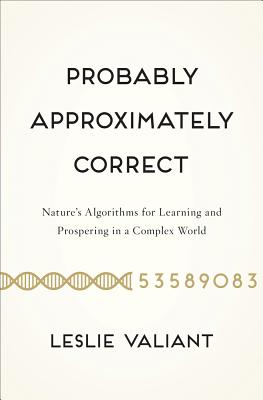
From a leading computer scientist, a unifying theory that will revolutionize our understanding of how life evolves and learns.
How does life prosper in a complex and erratic world? While we know that nature follows patterns -- such as the law of gravity -- our everyday lives are beyond what known science can predict. We nevertheless muddle through even in the absence of theories of how to act. But how do we do it?
In Probably Approximately Correct, computer scientist Leslie Valiant presents a masterful synthesis of learning and evolution to show how both individually and collectively we not only survive, but prosper in a world as complex as our own. The key is "probably approximately correct" algorithms, a concept Valiant developed to explain how effective behavior can be learned. The model shows that pragmatically coping with a problem can provide a satisfactory solution in the absence of any theory of the problem. After all, finding a mate does not require a theory of mating. Valiant's theory reveals the shared computational nature of evolution and learning, and sheds light on perennial questions such as nature versus nurture and the limits of artificial intelligence.
Offering a powerful and elegant model that encompasses life's complexity, Probably Approximately Correct has profound implications for how we think about behavior, cognition, biological evolution, and the possibilities and limits of human and machine intelligence.
Log in to write a review for this book.
No reviews yet. Be the first to share your opinion.
Biography not available.