Shiskowski, Kenneth M. Author
Biography not available.

Browse all FOLKLORE books
Browse all GARDENS books
Browse all GRAPHIC NOVELS books
Browse all HISTORY - MEDIEVAL books
Browse all HUMOUR books
Browse all Juvenile Fiction : Biographical - Other books
Browse all Juvenile Fiction : Historical - Other books
Browse all Juvenile Fiction : Legends, Myths, & Fables - Other books
Browse all Juvenile Fiction : People & Places - Other books
Browse all Juvenile Fiction : People & Places - United States - Other books
Browse all Juvenile Fiction : Religious - Other books
Browse all Juvenile Nonfiction : History - Other books
Browse all Juvenile Nonfiction : Mathematics - Advanced books
Browse all Juvenile Nonfiction : People & Places - Other books
Browse all Juvenile Nonfiction : People & Places - United States - Othe books
Browse all LITERARY STUDIES books
Browse all LONDON books
Browse all Medical : Nursing - Mental Health books
Browse all MIND books
Browse all MUSEOLOGY books
Browse all NON-CLASSIFIABLE books
Browse all NONLINEAR SCIENCE books
Browse all POPULAR SCIENCE books
Browse all RELIGIOUS STUDIES books
Browse all SPIRIT books
Browse all SPORT books
Browse all TRAVEL WRITING books
 Out of Stock
Hardback · ISBN 9780470637593
Inclusive of GST and other taxes
Arriving at your doorstep in 10-15 days
Our logisitcs team will make sure everyitem is delivered safely
| ISBN | 9780470637593 |
|---|---|
| Publisher | Wiley |
| Publication date | September 2010 |
| Language | English |
| MRP | £115.95 GBP |
| Page count | 614 |
| Item weight | 227 g |
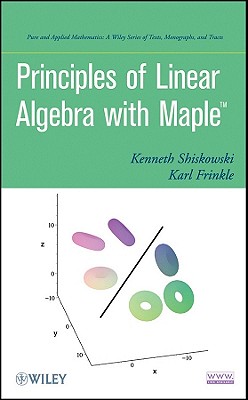
Many topics in linear algebra can be computationally intensive, and software programs often serve as important tools for understanding challenging concepts and visualizing the geometric aspects of the subject. Principles of Linear Algebra with Maple uniquely addresses the quickly growing intersection between subject theory and numerical computation, providing all of the commands required to solve complex and computationally challenging linear algebra problems using Maple. The authors supply an informal, accessible, and easy-to-follow treatment of key topics often found in a first course in linear algebra.
Requiring no prior knowledge of the software, the book begins with an introduction to the commands and programming guidelines for working with Maple. Next, the book explores linear systems of equations and matrices, applications of linear systems and matrices, determinants, inverses, and Cramer's rule. Basic linear algebra topics such as vectors, dot product, cross product, and vector projection are explained, as well as the more advanced topics of rotations in space, rolling a circle along a curve, and the TNB Frame. Subsequent chapters feature coverage of linear transformations from Rn to Rm, the geometry of linear and affine transformations, least squares fits and pseudoinverses, and eigenvalues and eigenvectors.
The authors explore several topics that are not often found in introductory linear algebra books, including sensitivity to error and the effects of linear and affine maps on the geometry of objects. The Maple software highlights the topic's visual nature, as the book is complete with numerous graphics in two and three dimensions, animations, symbolic manipulations, numerical computations, and programming. In addition, a related Web site features supplemental material, including Maple code for each chapter's problems, solutions, and color versions of the book's figures.
Extensively class-tested to ensure an accessible presentation, Principles of Linear Algebra with Maple is an excellent book for courses on linear algebra at the undergraduate level. It is also an ideal reference for students and professionals who would like to gain a further understanding of the use of Maple to solve linear algebra problems.
Log in to write a review for this book.
No reviews yet. Be the first to share your opinion.
Biography not available.