Anderson, Leslie E. Author
Biography not available.

Browse all ART CRITICISM books
Browse all Ashworth books
Browse all FOLKLORE books
Browse all GARDENS books
Browse all GRAPHIC NOVELS books
Browse all Hamilton books
Browse all HISTORY - MEDIEVAL books
Browse all HUMOUR books
Browse all KINDRED books
Browse all LITERARY STUDIES books
Browse all LONDON books
Browse all Lozada books
Browse all Medical : Nursing - Mental Health books
Browse all MIND books
Browse all MUSEOLOGY books
Browse all NON-CLASSIFIABLE books
Browse all NONLINEAR SCIENCE books
Browse all Ormonde books
Browse all POPULAR SCIENCE books
Browse all RELIGIOUS STUDIES books
Browse all SPIRIT books
Browse all SPORT books
Browse all TRAVEL WRITING books
 Out of Stock
Paperback · ISBN 9780521140843
Inclusive of GST and other taxes
Arriving at your doorstep in 10-15 days
Our logisitcs team will make sure everyitem is delivered safely
| ISBN | 9780521140843 |
|---|---|
| Publisher | Cambridge University Press |
| Publication date | May 2010 |
| Language | English |
| MRP | £32.00 GBP |
| Page count | 324 |
| Item weight | 110 g |
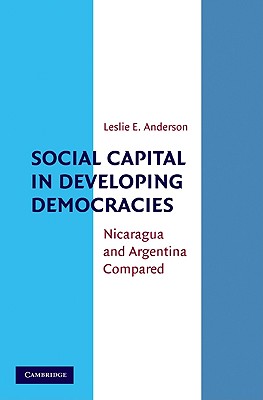
Drawing on extensive field work in Nicaragua and Argentina, as well as public opinion and elite data, Leslie E. Anderson's Social Capital in Developing Democracies explores the contribution of social capital to the process of democratization and the limits of that contribution. Anderson finds that in Nicaragua strong, positive, bridging social capital has enhanced democratization, while in Argentina the legacy of Peronism has created bonding and non-democratic social capital that perpetually undermines the development of democracy. Faced with the reality of an anti-democratic form of social capital, Anderson suggests that Argentine democracy is developing on the basis of an alternative resource - institutional capital. Anderson concludes that social capital can and does enhance democracy under historical conditions that have created horizontal ties among citizens, but that social capital can also undermine democratization where historical conditions have created vertical ties with leaders and suspicion or non-cooperation among citizens.
Log in to write a review for this book.
No reviews yet. Be the first to share your opinion.
Biography not available.