Simpson, Stephen G. Author
Biography not available.

Browse all ART CRITICISM books
Browse all Ashworth books
Browse all FOLKLORE books
Browse all GARDENS books
Browse all GRAPHIC NOVELS books
Browse all Hamilton books
Browse all HISTORY - MEDIEVAL books
Browse all HUMOUR books
Browse all KINDRED books
Browse all LITERARY STUDIES books
Browse all LONDON books
Browse all Lozada books
Browse all Medical : Nursing - Mental Health books
Browse all MIND books
Browse all MUSEOLOGY books
Browse all NON-CLASSIFIABLE books
Browse all NONLINEAR SCIENCE books
Browse all Ormonde books
Browse all POPULAR SCIENCE books
Browse all RELIGIOUS STUDIES books
Browse all SPIRIT books
Browse all SPORT books
Browse all TRAVEL WRITING books
 Out of Stock
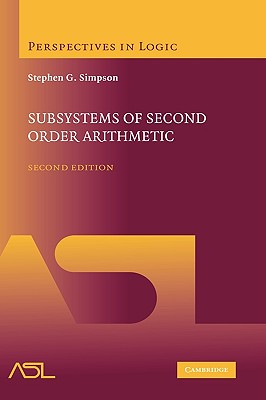
SUBSYSTEMS OF 2ND ORDER ARITHM
Paperback · ISBN 9780521150149
Inclusive of GST and other taxes
Arriving at your doorstep in 10-15 days
Our logisitcs team will make sure everyitem is delivered safely
| ISBN | 9780521150149 |
|---|---|
| Subtitle | SUBSYSTEMS OF 2ND ORDER ARITHM |
| Publisher | Cambridge University Press |
| Publication date | February 2010 |
| Language | English |
| MRP | £53.00 GBP |
| Page count | 464 |
| Item weight | 143 g |
Foundations of mathematics is the study of the most basic concepts and logical structure of mathematics, with an eye to the unity of human knowledge. Almost all of the problems studied in this book are motivated by an overriding foundational question: What are the appropriate axioms for mathematics? Through a series of case studies, these axioms are examined to prove particular theorems in core mathematical areas such as algebra, analysis, and topology, focusing on the language of second-order arithmetic, the weakest language rich enough to express and develop the bulk of mathematics. In many cases, if a mathematical theorem is proved from appropriately weak set existence axioms, then the axioms will be logically equivalent to the theorem. Furthermore, only a few specific set existence axioms arise repeatedly in this context, which in turn correspond to classical foundational programs. This is the theme of reverse mathematics, which dominates the first half of the book. The second part focuses on models of these and other subsystems of second-order arithmetic. Additional results are presented in an appendix.
Log in to write a review for this book.
No reviews yet. Be the first to share your opinion.
Biography not available.