Slater, Dan Author
Biography not available.

Browse all ART CRITICISM books
Browse all Ashworth books
Browse all FOLKLORE books
Browse all GARDENS books
Browse all GRAPHIC NOVELS books
Browse all Hamilton books
Browse all HISTORY - MEDIEVAL books
Browse all HUMOUR books
Browse all KINDRED books
Browse all LITERARY STUDIES books
Browse all LONDON books
Browse all Lozada books
Browse all Medical : Nursing - Mental Health books
Browse all MIND books
Browse all MUSEOLOGY books
Browse all NON-CLASSIFIABLE books
Browse all NONLINEAR SCIENCE books
Browse all Ormonde books
Browse all POPULAR SCIENCE books
Browse all RELIGIOUS STUDIES books
Browse all SPIRIT books
Browse all SPORT books
Browse all TRAVEL WRITING books
 Out of Stock
Hardback · ISBN 9780521190411
Inclusive of GST and other taxes
Arriving at your doorstep in 10-15 days
Our logisitcs team will make sure everyitem is delivered safely
| ISBN | 9780521190411 |
|---|---|
| Publisher | Cambridge University Press |
| Publication date | December 2010 |
| Language | English |
| MRP | £79.00 GBP |
| Page count | 346 |
| Item weight | 157 g |
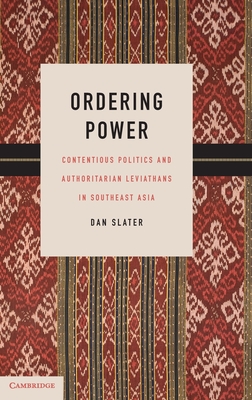
Like the postcolonial world more generally, Southeast Asia exhibits tremendous variation in state capacity and authoritarian durability. Ordering Power draws on theoretical insights dating back to Thomas Hobbes to develop a unified framework for explaining both of these political outcomes. States are especially strong and dictatorships especially durable when they have their origins in "protection pacts" broad elite coalitions unified by shared support for heightened state power and tightened authoritarian controls as bulwarks against especially threatening and challenging types of contentious politics. These coalitions provide the elite collective action underpinning strong states, robust ruling parties, cohesive militaries, and durable authoritarian regimes - all at the same time. Comparative-historical analysis of seven Southeast Asian countries (Burma, Indonesia, Malaysia, the Philippines, Singapore, South Vietnam, and Thailand) reveals that subtly divergent patterns of contentious politics after World War II provide the best explanation for the dramatic divergence in Southeast Asia's contemporary states and regimes.
Log in to write a review for this book.
No reviews yet. Be the first to share your opinion.
Biography not available.