Rorty, Richard Author
Biography not available.

Browse all FOLKLORE books
Browse all GARDENS books
Browse all GRAPHIC NOVELS books
Browse all HISTORY - MEDIEVAL books
Browse all HUMOUR books
Browse all Juvenile Fiction : Biographical - Other books
Browse all Juvenile Fiction : Historical - Other books
Browse all Juvenile Fiction : Legends, Myths, & Fables - Other books
Browse all Juvenile Fiction : People & Places - Other books
Browse all Juvenile Fiction : People & Places - United States - Other books
Browse all Juvenile Fiction : Religious - Other books
Browse all Juvenile Nonfiction : History - Other books
Browse all Juvenile Nonfiction : Mathematics - Advanced books
Browse all Juvenile Nonfiction : People & Places - Other books
Browse all Juvenile Nonfiction : People & Places - United States - Othe books
Browse all LITERARY STUDIES books
Browse all LONDON books
Browse all Medical : Nursing - Mental Health books
Browse all MIND books
Browse all MUSEOLOGY books
Browse all NON-CLASSIFIABLE books
Browse all NONLINEAR SCIENCE books
Browse all POPULAR SCIENCE books
Browse all RELIGIOUS STUDIES books
Browse all SPIRIT books
Browse all SPORT books
Browse all TRAVEL WRITING books
 Out of Stock
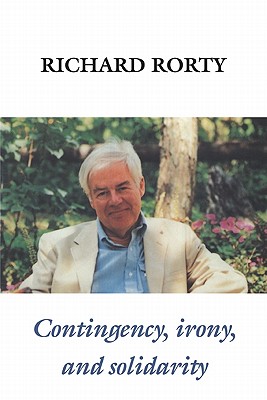
CONTINGENCY IRONY & SOLIDARITY
Paperback · ISBN 9780521367813
Inclusive of GST and other taxes
Arriving at your doorstep in 10-15 days
Our logisitcs team will make sure everyitem is delivered safely
| ISBN | 9780521367813 |
|---|---|
| Subtitle | CONTINGENCY IRONY & SOLIDARITY |
| Publisher | Cambridge University Press |
| Publication date | May 1989 |
| Language | English |
| MRP | £23.00 GBP |
| Page count | 220 |
| Item weight | 73 g |
In this book, major American philosopher Richard Rorty argues that thinkers such as Nietzsche, Freud, and Wittgenstein have enabled societies to see themselves as historical contingencies, rather than as expressions of underlying, ahistorical human nature, or as realizations of suprahistorical goals. This ironic perspective on the human condition is valuable but it cannot advance Liberalism's social and political goals. In fact, Rorty believes that it is literature and not philosophy that can do this, by promoting a genuine sense of human solidarity. Specifically, it is novelists such as Orwell and Nabokov who succeed in awakening us to the cruelty of particular social practices and individual attitudes. Thus, a truly liberal culture would fuse the private, individual freedom of the ironic, philosophical perspective with the public project of human solidarity as it is engendered through the insights and sensibilities of great writers. Rorty uses a wide range of references--from philosophy to social theory to literary criticism--to elucidate his beliefs.
Log in to write a review for this book.
No reviews yet. Be the first to share your opinion.
Biography not available.