Dawson, Michael E. Editor
Biography not available.

Browse all ART CRITICISM books
Browse all Ashworth books
Browse all FOLKLORE books
Browse all GARDENS books
Browse all GRAPHIC NOVELS books
Browse all Hamilton books
Browse all HISTORY - MEDIEVAL books
Browse all HUMOUR books
Browse all KINDRED books
Browse all LITERARY STUDIES books
Browse all LONDON books
Browse all Lozada books
Browse all Medical : Nursing - Mental Health books
Browse all MIND books
Browse all MUSEOLOGY books
Browse all NON-CLASSIFIABLE books
Browse all NONLINEAR SCIENCE books
Browse all Ormonde books
Browse all POPULAR SCIENCE books
Browse all RELIGIOUS STUDIES books
Browse all SPIRIT books
Browse all SPORT books
Browse all TRAVEL WRITING books
 Out of Stock
STARTLE MODIFICATION
Hardback · ISBN 9780521580465
Inclusive of GST and other taxes
Arriving at your doorstep in 10-15 days
Our logisitcs team will make sure everyitem is delivered safely
| ISBN | 9780521580465 |
|---|---|
| Subtitle | STARTLE MODIFICATION |
| Publisher | Cambridge University Press |
| Publication date | May 1999 |
| Language | English |
| MRP | £123.00 GBP |
| Page count | 400 |
| Item weight | 167 g |
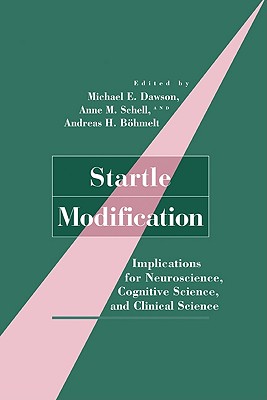
The startle response (as a result of a sudden, loud noise, for instance) is a reflex that is wired into the brain at a very basic level. Although everybody will exhibit such a reflex, the strength and quickness of the startle response is modified by a subject's underlying psychoneurological state. Therefore, the nature of this modification is now seen as an accurate, objective measure of very deep neurological processes. This book is the first comprehensive volume devoted to startle modification. It offers a unique overview of the methods, measurement, physiology, and psychology of the phenomenon, particularly modification of the human startle eyeblink. Many of the world's leading investigators in the field have made contributions to this volume. Coverage includes elicitation and recording of startle blink; issues in measurement and quantification; the neurophysiological basis of the basic startle response and its modification by attentional and affective processes; psychological processes underlying short and long lead interval modification (including prepulse inhibition); applications of startle modification to the study of psychopathology, including schizophrenia, affective disorders, and psychopathy and developmental processes; and relationships with ERPs and behavioral measures of information processing.
Log in to write a review for this book.
No reviews yet. Be the first to share your opinion.
Biography not available.
Biography not available.
Biography not available.