Kinard, James T. Author
Biography not available.

Browse all ART CRITICISM books
Browse all Ashworth books
Browse all FOLKLORE books
Browse all GARDENS books
Browse all GRAPHIC NOVELS books
Browse all Hamilton books
Browse all HISTORY - MEDIEVAL books
Browse all HUMOUR books
Browse all KINDRED books
Browse all LITERARY STUDIES books
Browse all LONDON books
Browse all Lozada books
Browse all Medical : Nursing - Mental Health books
Browse all MIND books
Browse all MUSEOLOGY books
Browse all NON-CLASSIFIABLE books
Browse all NONLINEAR SCIENCE books
Browse all Ormonde books
Browse all POPULAR SCIENCE books
Browse all RELIGIOUS STUDIES books
Browse all SPIRIT books
Browse all SPORT books
Browse all TRAVEL WRITING books
 Out of Stock
Paperback · ISBN 9780521700269
Inclusive of GST and other taxes
Arriving at your doorstep in 10-15 days
Our logisitcs team will make sure everyitem is delivered safely
| ISBN | 9780521700269 |
|---|---|
| Publisher | Cambridge University Press |
| Publication date | November 2008 |
| Language | English |
| MRP | £29.00 GBP |
| Page count | 216 |
| Item weight | 72 g |
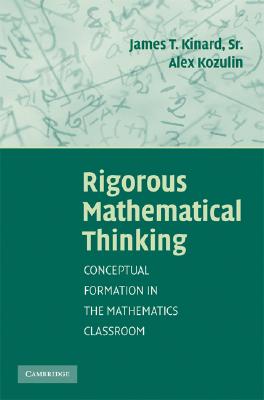
This book demonstrates how rigorous mathematical thinking can be fostered through the development of students' cognitive tools and operations. Though this approach can be applied in any classroom, it seems to be particularly effective with socially disadvantaged and culturally different students. The authors argue that children's cognitive functions cannot be viewed as following a natural maturational path: They should be actively constructed during the educational process. The Rigorous Mathematical Thinking (RMT) model is based on two major theoretical approaches allowing such an active construction - Vygotsky's theory of psychological tools and Feuerstein's concept of mediated learning experience. The book starts with general cognitive tools that are essential for all types of problem solving and then moves to mathematically specific cognitive tools and methods for utilizing these tools for mathematical conceptual formation. The application of the RMT model in various urban classrooms demonstrates how mathematics education standards can be reached even by the students with a history of educational failure who were considered hopeless underachievers.
Log in to write a review for this book.
No reviews yet. Be the first to share your opinion.
Biography not available.
Biography not available.