Taylor, Alan D. Author
Biography not available.

Browse all FOLKLORE books
Browse all GARDENS books
Browse all GRAPHIC NOVELS books
Browse all HISTORY - MEDIEVAL books
Browse all HUMOUR books
Browse all Juvenile Fiction : Biographical - Other books
Browse all Juvenile Fiction : Historical - Other books
Browse all Juvenile Fiction : Legends, Myths, & Fables - Other books
Browse all Juvenile Fiction : People & Places - Other books
Browse all Juvenile Fiction : People & Places - United States - Other books
Browse all Juvenile Fiction : Religious - Other books
Browse all Juvenile Nonfiction : History - Other books
Browse all Juvenile Nonfiction : Mathematics - Advanced books
Browse all Juvenile Nonfiction : People & Places - Other books
Browse all Juvenile Nonfiction : People & Places - United States - Othe books
Browse all LITERARY STUDIES books
Browse all LONDON books
Browse all Medical : Nursing - Mental Health books
Browse all MIND books
Browse all MUSEOLOGY books
Browse all NON-CLASSIFIABLE books
Browse all NONLINEAR SCIENCE books
Browse all POPULAR SCIENCE books
Browse all RELIGIOUS STUDIES books
Browse all SPIRIT books
Browse all SPORT books
Browse all TRAVEL WRITING books
 Out of Stock
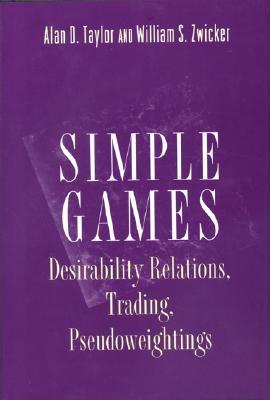
SIMPLE GAMES
Hardback · ISBN 9780691001203
Inclusive of GST and other taxes
Arriving at your doorstep in 10-15 days
Our logisitcs team will make sure everyitem is delivered safely
| ISBN | 9780691001203 |
|---|---|
| Subtitle | SIMPLE GAMES |
| Publisher | Princeton University Press |
| Publication date | October 1999 |
| Language | English |
| MRP | £142.00 GBP |
| Page count | 264 |
| Item weight | 117 g |
Simple games are mathematical structures inspired by voting systems in which a single alternative, such as a bill, is pitted against the status quo. The first in-depth mathematical study of the subject as a coherent subfield of finite combinatorics--one with its own organized body of techniques and results--this book blends new theorems with some of the striking results from threshold logic, making all of it accessible to game theorists. Introductory material receives a fresh treatment, with an emphasis on Boolean subgames and the Rudin-Keisler order as unifying concepts. Advanced material focuses on the surprisingly wide variety of properties related to the weightedness of a game.
A desirability relation orders the individuals or coalitions of a game according to their influence in the corresponding voting system. As Taylor and Zwicker show, acyclicity of such a relation approximates weightedness--the more sensitive the relation, the closer the approximation. A trade is an exchange of players among coalitions, and robustness under such trades is equivalent to weightedness of the game. Robustness under trades that fit some restrictive exchange pattern typically characterizes a wider class of simple games--for example, games for which some particular desirability order is acyclic. Finally, one can often describe these wider classes of simple games by weakening the total additivity of a weighting to obtain what is called a pseudoweighting. In providing such uniform explanations for many of the structural properties of simple games, this book showcases numerous new techniques and results.
Log in to write a review for this book.
No reviews yet. Be the first to share your opinion.
Biography not available.
Biography not available.