Hoeckner, Berthold Author
Biography not available.

Browse all FOLKLORE books
Browse all GARDENS books
Browse all GRAPHIC NOVELS books
Browse all HISTORY - MEDIEVAL books
Browse all HUMOUR books
Browse all Juvenile Fiction : Biographical - Other books
Browse all Juvenile Fiction : Historical - Other books
Browse all Juvenile Fiction : Legends, Myths, & Fables - Other books
Browse all Juvenile Fiction : People & Places - Other books
Browse all Juvenile Fiction : People & Places - United States - Other books
Browse all Juvenile Fiction : Religious - Other books
Browse all Juvenile Nonfiction : History - Other books
Browse all Juvenile Nonfiction : Mathematics - Advanced books
Browse all Juvenile Nonfiction : People & Places - Other books
Browse all Juvenile Nonfiction : People & Places - United States - Othe books
Browse all LITERARY STUDIES books
Browse all LONDON books
Browse all Medical : Nursing - Mental Health books
Browse all MIND books
Browse all MUSEOLOGY books
Browse all NON-CLASSIFIABLE books
Browse all NONLINEAR SCIENCE books
Browse all POPULAR SCIENCE books
Browse all RELIGIOUS STUDIES books
Browse all SPIRIT books
Browse all SPORT books
Browse all TRAVEL WRITING books
 Out of Stock
PROGRAMMING THE ABSOLUTE
Hardback · ISBN 9780691001494
Inclusive of GST and other taxes
Arriving at your doorstep in 10-15 days
Our logisitcs team will make sure everyitem is delivered safely
| ISBN | 9780691001494 |
|---|---|
| Subtitle | PROGRAMMING THE ABSOLUTE |
| Publisher | Princeton University Press |
| Publication date | November 2002 |
| Language | English |
| MRP | £105.00 GBP |
| Page count | 368 |
| Item weight | 149 g |
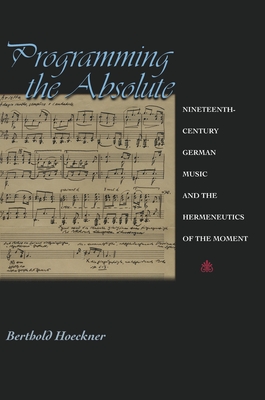
Programming the Absolute discusses the notorious opposition between absolute and program music as a true dialectic that lies at the heart of nineteenth-century German music. Beginning with Beethoven, Berthold Hoeckner traces the aesthetic problem of musical meaning in works by Schumann, Wagner, Liszt, Mahler, and Schoenberg, whose private messages and public predicaments are emblematic for the cultural legacy of this rich repertory.
After Romanticism had elevated music as a language "beyond" language, the ineffable spurred an unprecedented proliferation of musical analysis and criticism. Taking his cue from Adorno, Hoeckner develops the idea of a "hermeneutics of a moment," which holds that musical meaning crystallizes only momentarily--in a particular passage, a progression, even a single note. And such moments can signify as little as a fleeting personal memory or as much as the whole of German music.
Although absolute music emerged with a matrix of values--the integrity of the subject, the aesthetic autonomy of art, and the intrinsic worth of high culture--that are highly contested in musicology today, Hoeckner argues that we should not completely discard the ideal of a music that continues to offer moments of transcendence and liberation.
Passionately and artfully written, Hoeckner's quest for an "essayistic musicology" displays an original intelligence willing to take interpretive risks. It is a provocative contribution to our knowledge about some of Europe's most important music--and to contemporary controversies over how music should be understood and experienced.
Log in to write a review for this book.
No reviews yet. Be the first to share your opinion.
Biography not available.