Milnor, John Author
Biography not available.

Browse all ART CRITICISM books
Browse all Ashworth books
Browse all FOLKLORE books
Browse all GARDENS books
Browse all GRAPHIC NOVELS books
Browse all Hamilton books
Browse all HISTORY - MEDIEVAL books
Browse all HUMOUR books
Browse all KINDRED books
Browse all LITERARY STUDIES books
Browse all LONDON books
Browse all Lozada books
Browse all Medical : Nursing - Mental Health books
Browse all MIND books
Browse all MUSEOLOGY books
Browse all NON-CLASSIFIABLE books
Browse all NONLINEAR SCIENCE books
Browse all Ormonde books
Browse all POPULAR SCIENCE books
Browse all RELIGIOUS STUDIES books
Browse all SPIRIT books
Browse all SPORT books
Browse all TRAVEL WRITING books
 Out of Stock
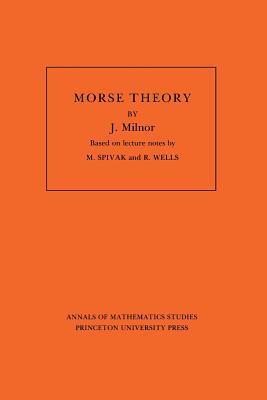
MORSE THEORY (AM-51)
Paperback · ISBN 9780691080086
Inclusive of GST and other taxes
Arriving at your doorstep in 10-15 days
Our logisitcs team will make sure everyitem is delivered safely
| ISBN | 9780691080086 |
|---|---|
| Subtitle | MORSE THEORY (AM-51) |
| Publisher | Princeton University Press |
| Publication date | May 1963 |
| Language | English |
| MRP | £75.00 GBP |
| Page count | 162 |
| Item weight | 52 g |
One of the most cited books in mathematics, John Milnor's exposition of Morse theory has been the most important book on the subject for more than forty years. Morse theory was developed in the 1920s by mathematician Marston Morse. (Morse was on the faculty of the Institute for Advanced Study, and Princeton published his Topological Methods in the Theory of Functions of a Complex Variable in the Annals of Mathematics Studies series in 1947.) One classical application of Morse theory includes the attempt to understand, with only limited information, the large-scale structure of an object. This kind of problem occurs in mathematical physics, dynamic systems, and mechanical engineering. Morse theory has received much attention in the last two decades as a result of a famous paper in which theoretical physicist Edward Witten relates Morse theory to quantum field theory.
Milnor was awarded the Fields Medal (the mathematical equivalent of a Nobel Prize) in 1962 for his work in differential topology. He has since received the National Medal of Science (1967) and the Steele Prize from the American Mathematical Society twice (1982 and 2004) in recognition of his explanations of mathematical concepts across a wide range of scienti.c disciplines. The citation reads, "The phrase sublime elegance is rarely associated with mathematical exposition, but it applies to all of Milnor's writings. Reading his books, one is struck with the ease with which the subject is unfolding and it only becomes apparent after re.ection that this ease is the mark of a master.?
Milnor has published five books with Princeton University Press.
Log in to write a review for this book.
No reviews yet. Be the first to share your opinion.
Biography not available.