Negroni, María|Twitty, Anne Author
Biography not available.

Browse all ART CRITICISM books
Browse all Ashworth books
Browse all FOLKLORE books
Browse all GARDENS books
Browse all GRAPHIC NOVELS books
Browse all Hamilton books
Browse all HISTORY - MEDIEVAL books
Browse all HUMOUR books
Browse all KINDRED books
Browse all LITERARY STUDIES books
Browse all LONDON books
Browse all Lozada books
Browse all Medical : Nursing - Mental Health books
Browse all MIND books
Browse all MUSEOLOGY books
Browse all NON-CLASSIFIABLE books
Browse all NONLINEAR SCIENCE books
Browse all Ormonde books
Browse all POPULAR SCIENCE books
Browse all RELIGIOUS STUDIES books
Browse all SPIRIT books
Browse all SPORT books
Browse all TRAVEL WRITING books
 Out of Stock
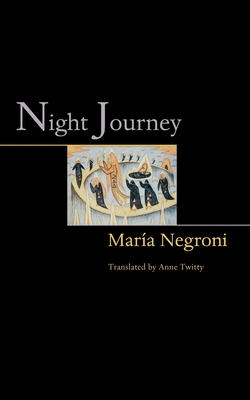
NIGHT JOURNEY
Paperback · ISBN 9780691090986
Inclusive of GST and other taxes
Arriving at your doorstep in 10-15 days
Our logisitcs team will make sure everyitem is delivered safely
| ISBN | 9780691090986 |
|---|---|
| Subtitle | NIGHT JOURNEY |
| Publisher | Princeton University Press |
| Publication date | February 2002 |
| Language | English |
| MRP | £28.00 GBP |
| Page count | 148 |
| Item weight | 37 g |
One of South America's most celebrated contemporary poets takes us on a fantastic voyage to mysterious lands and seas, into the psyche, and to the heart of the poem itself. Night Journey is the English-language debut of the work that won María Negroni an Argentine National Book Award. It is a book of dreams--dreams she renders with surreal beauty that recalls the work of her compatriot Alejandra Pizarnik, with the penetrating subtlety of Borges and Calvino.
In sixty-two tightly woven prose poems, Negroni deftly infuses haunting imagery with an ironic, personal spirituality. Effortlessly she navigates the nameless subject to the slopes of the Himalayas, to a bar in Buenos Aires, through war, from icy Scandinavian landscapes to the tropics, across seas, toward a cemetery in the wake of Napoleon's hearse, by train, by taxis headed in unrequested directions, past mirrors and birds, between life and death.
Night Journey reflects a mastery of a traditional form while brilliantly expressing a modern condition: the multicultural, multifaceted individual, ever in motion. Displacement abounds: a "medieval tabard" where a pelvis should be, a "lipless grin," a "beach severed from the ocean." In one poem "nomadic cities" whisk past. In another, smiling cockroaches loom in a visiting mother's eyes.
Anne Twitty, whose elegant translations are accompanied by the Spanish originals, remarks in her preface that the book's "indomitable literary intelligence" subdues an unspoken terror--helplessness. Yet, as observed by the angel Gabriel, the consoling voice of wisdom, only by accepting the journey for what it is can one discover its "hidden splendor," the "invisible center of the poem." As readers of this magnificent work will discover, this is a journey that, because its every fleeting image conjures a thousand words of fertile silence, can be savored again and again.
Log in to write a review for this book.
No reviews yet. Be the first to share your opinion.
Biography not available.