Rustem, Berç|Howe, Melendres Author
Biography not available.

Browse all FOLKLORE books
Browse all GARDENS books
Browse all GRAPHIC NOVELS books
Browse all HISTORY - MEDIEVAL books
Browse all HUMOUR books
Browse all Juvenile Fiction : Biographical - Other books
Browse all Juvenile Fiction : Historical - Other books
Browse all Juvenile Fiction : Legends, Myths, & Fables - Other books
Browse all Juvenile Fiction : People & Places - Other books
Browse all Juvenile Fiction : People & Places - United States - Other books
Browse all Juvenile Fiction : Religious - Other books
Browse all Juvenile Nonfiction : History - Other books
Browse all Juvenile Nonfiction : Mathematics - Advanced books
Browse all Juvenile Nonfiction : People & Places - Other books
Browse all Juvenile Nonfiction : People & Places - United States - Othe books
Browse all LITERARY STUDIES books
Browse all LONDON books
Browse all Medical : Nursing - Mental Health books
Browse all MIND books
Browse all MUSEOLOGY books
Browse all NON-CLASSIFIABLE books
Browse all NONLINEAR SCIENCE books
Browse all POPULAR SCIENCE books
Browse all RELIGIOUS STUDIES books
Browse all SPIRIT books
Browse all SPORT books
Browse all TRAVEL WRITING books
 Out of Stock
ALGORITHMS FOR WORST-CASE DESI
Hardback · ISBN 9780691091549
Inclusive of GST and other taxes
Arriving at your doorstep in 10-15 days
Our logisitcs team will make sure everyitem is delivered safely
| ISBN | 9780691091549 |
|---|---|
| Subtitle | ALGORITHMS FOR WORST-CASE DESI |
| Publisher | Princeton University Press |
| Publication date | September 2002 |
| Language | English |
| MRP | £155.00 GBP |
| Page count | 408 |
| Item weight | 177 g |
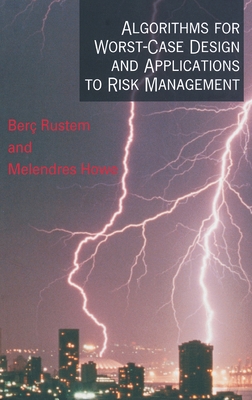
Recognizing that robust decision making is vital in risk management, this book provides concepts and algorithms for computing the best decision in view of the worst-case scenario. The main tool used is minimax, which ensures robust policies with guaranteed optimal performance that will improve further if the worst case is not realized. The applications considered are drawn from finance, but the design and algorithms presented are equally applicable to problems of economic policy, engineering design, and other areas of decision making.
Critically, worst-case design addresses not only Armageddon-type uncertainty. Indeed, the determination of the worst case becomes nontrivial when faced with numerous--possibly infinite--and reasonably likely rival scenarios. Optimality does not depend on any single scenario but on all the scenarios under consideration. Worst-case optimal decisions provide guaranteed optimal performance for systems operating within the specified scenario range indicating the uncertainty. The noninferiority of minimax solutions--which also offer the possibility of multiple maxima--ensures this optimality.
Worst-case design is not intended to necessarily replace expected value optimization when the underlying uncertainty is stochastic. However, wise decision making requires the justification of policies based on expected value optimization in view of the worst-case scenario. Conversely, the cost of the assured performance provided by robust worst-case decision making needs to be evaluated relative to optimal expected values.
Written for postgraduate students and researchers engaged in optimization, engineering design, economics, and finance, this book will also be invaluable to practitioners in risk management.
Log in to write a review for this book.
No reviews yet. Be the first to share your opinion.
Biography not available.