De Gandt, François Author
Biography not available.

Browse all FOLKLORE books
Browse all GARDENS books
Browse all GRAPHIC NOVELS books
Browse all HISTORY - MEDIEVAL books
Browse all HUMOUR books
Browse all Juvenile Fiction : Biographical - Other books
Browse all Juvenile Fiction : Historical - Other books
Browse all Juvenile Fiction : Legends, Myths, & Fables - Other books
Browse all Juvenile Fiction : People & Places - Other books
Browse all Juvenile Fiction : People & Places - United States - Other books
Browse all Juvenile Fiction : Religious - Other books
Browse all Juvenile Nonfiction : History - Other books
Browse all Juvenile Nonfiction : Mathematics - Advanced books
Browse all Juvenile Nonfiction : People & Places - Other books
Browse all Juvenile Nonfiction : People & Places - United States - Othe books
Browse all LITERARY STUDIES books
Browse all LONDON books
Browse all Medical : Nursing - Mental Health books
Browse all MIND books
Browse all MUSEOLOGY books
Browse all NON-CLASSIFIABLE books
Browse all NONLINEAR SCIENCE books
Browse all POPULAR SCIENCE books
Browse all RELIGIOUS STUDIES books
Browse all SPIRIT books
Browse all SPORT books
Browse all TRAVEL WRITING books
 Out of Stock
Hardback · ISBN 9780691631981
Inclusive of GST and other taxes
Arriving at your doorstep in 10-15 days
Our logisitcs team will make sure everyitem is delivered safely
| ISBN | 9780691631981 |
|---|---|
| Publisher | Princeton University Press |
| Publication date | April 2016 |
| Language | English |
| MRP | £155.00 GBP |
| Page count | 312 |
| Item weight | 136 g |
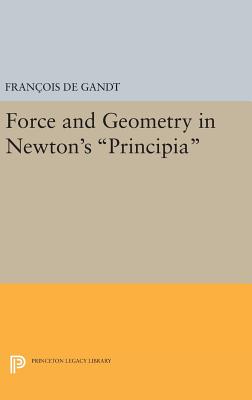
In this book François De Gandt introduces us to the reading of Newton's Principia in its own terms. The path of access that De Gandt proposes leads through the study of the geometrization of force. The result is a highly original meditation on the sources and meaning of Newton's magnum opus.
In Chapter I De Gandt presents a translation of and detailed commentary on an earlier and simpler version of what in 1687 became Book I of the Principia; here in clearer and starker outline than in the final version, the basic principles of Newton's dynamics show forth. Chapter II places this dynamics in the intellectual context of earlier efforts--the first seeds of celestial dynamics in Kepler, Galileo's theory of accelerated motion, and Huygens's quantification of centrifugal force--and evaluates Newton's debt to these thinkers. Chapter III is a study of the mathematical tools used by Newton and their intellectual antecedents in the works of Galileo, Torricelli, Barrow, and other seventeenth-century mathematicians. The conclusion discusses the new status of force and cause in the science that emerges from Newton's Principia.
Originally published in 1995.
The Princeton Legacy Library uses the latest print-on-demand technology to again make available previously out-of-print books from the distinguished backlist of Princeton University Press. These editions preserve the original texts of these important books while presenting them in durable paperback and hardcover editions. The goal of the Princeton Legacy Library is to vastly increase access to the rich scholarly heritage found in the thousands of books published by Princeton University Press since its founding in 1905.
Log in to write a review for this book.
No reviews yet. Be the first to share your opinion.
Biography not available.
Biography not available.