Ferman, Barbara Author
Biography not available.

Browse all ART CRITICISM books
Browse all Ashworth books
Browse all FOLKLORE books
Browse all GARDENS books
Browse all GRAPHIC NOVELS books
Browse all Hamilton books
Browse all HISTORY - MEDIEVAL books
Browse all HUMOUR books
Browse all Juvenile Fiction : Biographical - Other books
Browse all Juvenile Fiction : Historical - Other books
Browse all Juvenile Fiction : Legends, Myths, & Fables - Other books
Browse all Juvenile Fiction : People & Places - Other books
Browse all Juvenile Fiction : People & Places - United States - Other books
Browse all Juvenile Fiction : Religious - Other books
Browse all Juvenile Nonfiction : History - Other books
Browse all Juvenile Nonfiction : Mathematics - Advanced books
Browse all Juvenile Nonfiction : People & Places - Other books
Browse all Juvenile Nonfiction : People & Places - United States - Othe books
Browse all KINDRED books
Browse all LITERARY STUDIES books
Browse all LONDON books
Browse all Lozada books
Browse all Medical : Nursing - Mental Health books
Browse all MIND books
Browse all MUSEOLOGY books
Browse all NON-CLASSIFIABLE books
Browse all NONLINEAR SCIENCE books
Browse all Ormonde books
Browse all POPULAR SCIENCE books
Browse all RELIGIOUS STUDIES books
Browse all SPIRIT books
Browse all SPORT books
Browse all TRAVEL WRITING books
 Out of Stock
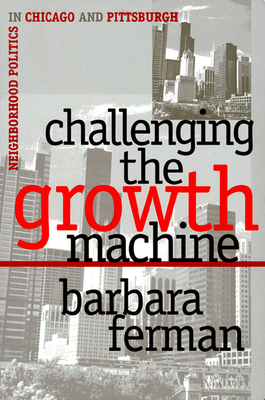
CHALLENGING THE GROWTH MACHINE
Paperback · ISBN 9780700607877
Inclusive of GST and other taxes
Arriving at your doorstep in 10-15 days
Our logisitcs team will make sure everyitem is delivered safely
| ISBN | 9780700607877 |
|---|---|
| Subtitle | CHALLENGING THE GROWTH MACHINE |
| Publisher | University Press Of Kansas |
| Publication date | September 1996 |
| Language | English |
| MRP | £21.95 GBP |
| Page count | 212 |
| Item weight | 70 g |
In this illuminating comparative study, Barbara Ferman demonstrates why neighborhood challenges to pro-growth politics were much more successful in Pittsburgh than they were in Chicago. Operating largely in the civic arena, Pittsburgh's neighborhood groups encountered a political culture and institutional structure conducive to empowering neighborhood progressivism in housing and economic development policymaking. In contrast, the pro-growth agenda in Chicago was challenged in the electoral arena, which was dominated by machine, ward-based politicians who regarded any independent neighborhood organizing as a threat. Consequently, neighborhood demands for policymaking input were usually thwarted.
Besides revealing why the development policies of two important American cities diverged, Ferman's unique comparative approach to this issue significantly expands the scope of urban analysis. Among other things, it provides the first serious study to incorporate the civic sector--neighborhood politics--as an important component of urban regimes. Ferman also emphasizes institutional and cultural factors--often ignored or relegated to residual roles in other studies--and expounds on their influence in shaping local politics and policy. To add an analytical and normative dimension to urban analysis, she focuses on the "non-elite" actors, not just the economic and political elites who compose governing coalitions.
Ultimately, Ferman takes a more holistic and balanced view of large cities than is typical for urban studies as she argues that neighborhoods are an important, integral part of what cities are and can be. For that reason especially, her work will have a profound impact upon our understanding of urban politics.
Log in to write a review for this book.
No reviews yet. Be the first to share your opinion.
Biography not available.