Kleene, S. C. Author
Biography not available.

Browse all FOLKLORE books
Browse all GARDENS books
Browse all GRAPHIC NOVELS books
Browse all HISTORY - MEDIEVAL books
Browse all HUMOUR books
Browse all Juvenile Fiction : Biographical - Other books
Browse all Juvenile Fiction : Historical - Other books
Browse all Juvenile Fiction : Legends, Myths, & Fables - Other books
Browse all Juvenile Fiction : People & Places - Other books
Browse all Juvenile Fiction : People & Places - United States - Other books
Browse all Juvenile Fiction : Religious - Other books
Browse all Juvenile Nonfiction : History - Other books
Browse all Juvenile Nonfiction : Mathematics - Advanced books
Browse all Juvenile Nonfiction : People & Places - Other books
Browse all Juvenile Nonfiction : People & Places - United States - Othe books
Browse all LITERARY STUDIES books
Browse all LONDON books
Browse all Medical : Nursing - Mental Health books
Browse all MIND books
Browse all MUSEOLOGY books
Browse all NON-CLASSIFIABLE books
Browse all NONLINEAR SCIENCE books
Browse all POPULAR SCIENCE books
Browse all RELIGIOUS STUDIES books
Browse all SPIRIT books
Browse all SPORT books
Browse all TRAVEL WRITING books
 Out of Stock
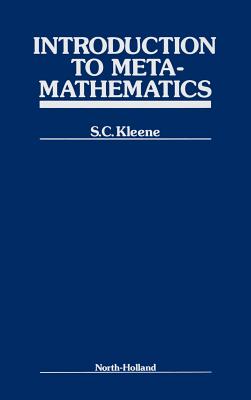
INTRO TO METAMATHEMATICS
Hardback · ISBN 9780720421033
Inclusive of GST and other taxes
Arriving at your doorstep in 10-15 days
Our logisitcs team will make sure everyitem is delivered safely
| ISBN | 9780720421033 |
|---|---|
| Subtitle | INTRO TO METAMATHEMATICS |
| Publisher | Butterworth-Heinemann |
| Publication date | September 2000 |
| Language | English |
| MRP | £99.00 GBP |
| Page count | 564 |
| Item weight | 203 g |
Stephen Cole Kleene was one of the greatest logicians of the twentieth century and this book is the influential textbook he wrote to teach the subject to the next generation. It was first published in 1952, some twenty years after the publication of Gadel's paper on the incompleteness of arithmetic, which marked, if not the beginning of modern logic, at least a turning point after which nothing was ever the same. Kleene was an important figure in logic, and lived a long full life of scholarship and teaching. The 1930s was a time of creativity and ferment in the subject, when the notion of computable moved from the realm of philosophical speculation to the realm of science. This was accomplished by the work of Kurt Gade1, Alan Turing, and Alonzo Church, who gave three apparently different precise definitions of computable. When they all turned out to be equivalent, there was a collective realization that this was indeed the right notion. Kleene played a key role in this process. One could say that he was there at the beginning of modern logic. He showed the equivalence of lambda calculus with Turing machines and with Gadel's recursion equations, and developed the modern machinery of partial recursive functions. This textbook played an invaluable part in educating the logicians of the present. It played an important role in their own logical education.
Log in to write a review for this book.
No reviews yet. Be the first to share your opinion.
Biography not available.
Biography not available.
Biography not available.