Welsh, John F. Author
Biography not available.

Browse all FOLKLORE books
Browse all GARDENS books
Browse all GRAPHIC NOVELS books
Browse all HISTORY - MEDIEVAL books
Browse all HUMOUR books
Browse all Juvenile Fiction : Biographical - Other books
Browse all Juvenile Fiction : Historical - Other books
Browse all Juvenile Fiction : Legends, Myths, & Fables - Other books
Browse all Juvenile Fiction : People & Places - Other books
Browse all Juvenile Fiction : People & Places - United States - Other books
Browse all Juvenile Fiction : Religious - Other books
Browse all Juvenile Nonfiction : History - Other books
Browse all Juvenile Nonfiction : Mathematics - Advanced books
Browse all Juvenile Nonfiction : People & Places - Other books
Browse all Juvenile Nonfiction : People & Places - United States - Othe books
Browse all LITERARY STUDIES books
Browse all LONDON books
Browse all Medical : Nursing - Mental Health books
Browse all MIND books
Browse all MUSEOLOGY books
Browse all NON-CLASSIFIABLE books
Browse all NONLINEAR SCIENCE books
Browse all POPULAR SCIENCE books
Browse all RELIGIOUS STUDIES books
Browse all SPIRIT books
Browse all SPORT books
Browse all TRAVEL WRITING books
 Out of Stock
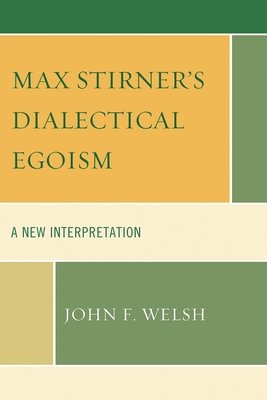
MAX STIRNERS DIALECTICAL EGOIS
Paperback · ISBN 9780739141564
Inclusive of GST and other taxes
Arriving at your doorstep in 10-15 days
Our logisitcs team will make sure everyitem is delivered safely
| ISBN | 9780739141564 |
|---|---|
| Subtitle | MAX STIRNERS DIALECTICAL EGOIS |
| Publisher | Lexington Books |
| Publication date | September 2010 |
| Language | English |
| MRP | £49.99 GBP |
| Page count | 306 |
| Item weight | 100 g |
Max Stirner (1806-1856) is recognized in the history of political thought because of his egoist classic The Ego and Its Own. Stirner was a student of Hegel, and a critic of the Young Hegelians and the emerging forms of socialist and communist thought in the 1840s. Max Stirner's Dialectical Egoism: A New Interpretation examines Stirner's thought as a critique of modernity, by which he meant the domination of culture and politics by humanist ideology. In Stirner's view, "humanity" is the supreme being of modernity and "humanism" is the prevailing legitimation of social and political domination.
Welsh traces Stirner's thought from his early essays to The Ego and Its Own and Stirner's responses to his critics. He also examines how Benjamin Tucker, James L. Walker, and Dora Marsden applied Stirner's dialectical egoism to the analysis of (a) the transformations of capitalism, (b) culture, ethics, and mass psychology, and (c) feminism, socialism, and communism. All three viewed Stirner as a champion of individuality against the collectivizing and homogenizing forces of the modern world.
Welsh also takes great care to dissociate Stirner's thought from that of the other great egoist critic of modernity, Friedrich Nietzsche. He argues that the similarities in the dissidence of Stirner and Nietzsche are superficial. The book concludes with an interpretation of Stirner's thought as a form of dialectical egoism that includes (a) a multi-tiered analysis of culture, society, and individuality; (b) the basic principles of Stirner's view of the relationship between individuals and social organization; and (c) the forms of critique he employs. Stirner's critique of modernity is a significant contribution to the growing literature on libertarianism, dialectical analysis, and post-modernism.
Log in to write a review for this book.
No reviews yet. Be the first to share your opinion.
Biography not available.