Dilworth, Craig Author
Biography not available.

Browse all ART CRITICISM books
Browse all Ashworth books
Browse all FOLKLORE books
Browse all GARDENS books
Browse all GRAPHIC NOVELS books
Browse all Hamilton books
Browse all HISTORY - MEDIEVAL books
Browse all HUMOUR books
Browse all Juvenile Fiction : Biographical - Other books
Browse all Juvenile Fiction : Historical - Other books
Browse all Juvenile Fiction : Legends, Myths, & Fables - Other books
Browse all Juvenile Fiction : People & Places - Other books
Browse all Juvenile Fiction : People & Places - United States - Other books
Browse all Juvenile Fiction : Religious - Other books
Browse all Juvenile Nonfiction : History - Other books
Browse all Juvenile Nonfiction : Mathematics - Advanced books
Browse all Juvenile Nonfiction : People & Places - Other books
Browse all Juvenile Nonfiction : People & Places - United States - Othe books
Browse all KINDRED books
Browse all LITERARY STUDIES books
Browse all LONDON books
Browse all Lozada books
Browse all Medical : Nursing - Mental Health books
Browse all MIND books
Browse all MUSEOLOGY books
Browse all NON-CLASSIFIABLE books
Browse all NONLINEAR SCIENCE books
Browse all Ormonde books
Browse all POPULAR SCIENCE books
Browse all RELIGIOUS STUDIES books
Browse all SPIRIT books
Browse all SPORT books
Browse all TRAVEL WRITING books
 Out of Stock
SIMPLICITY
Hardback · ISBN 9780739177235
Inclusive of GST and other taxes
Arriving at your doorstep in 10-15 days
Our logisitcs team will make sure everyitem is delivered safely
| ISBN | 9780739177235 |
|---|---|
| Subtitle | SIMPLICITY |
| Publisher | Lexington Books |
| Publication date | November 2012 |
| Language | English |
| MRP | £95.00 GBP |
| Page count | 202 |
| Item weight | 104 g |
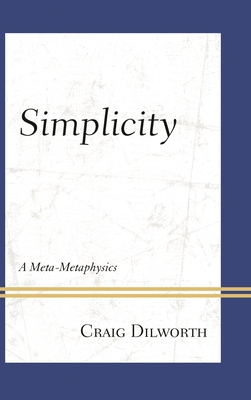
Simplicity presents a new, wide-ranging philosophical theory, one that concerns how reality is conceived. In so doing it also provides a new logic with which to approach conceptual situations. In this book, Craig Dilworth replaces the dualistic, true/false approach of formal logic with a three-part basis for thought. This basis consists of the categories of simplicity, complexity, and nothingness. The category of simplicity is paradoxical, while that of complexity is unproblematic, and that of nothingness is self-contradictory. When applied to ontological categories, such as those of substance, self, or causality, these categories of reason can resolve, rather than solve, intellectual issues.
The notion of perspective is integral to the simplicity way of thinking. A particular entity--such as the self--may be conceived as simple in one perspective, while being complex or nothing in another. Combined with the categories of the simplicity theory, Dilworth uses the notion of perspective to reveal a type of conceptual conflict that differs from contradiction. So, for example, simplicity better represents the relation between competing scientific theories--such as the wave and particle theories of radiation--as a form of perspectival incompatibility. The book distinguishes between two forms of simplicity: analytic and synthetic, which can respectively be conceived of as a point and a whole. Again, the notion of perspective is employed: what is analytically simple in one perspective may well be synthetically simple in another. In this book, the simplicity way of thinking is applied to intellectual issues in philosophy, set theory, and physics. These applications show how simplicity can provide real insight into a wide variety of conceptually complex situations.
Log in to write a review for this book.
No reviews yet. Be the first to share your opinion.
Biography not available.