Attard, Phil Author
Biography not available.

Browse all ART CRITICISM books
Browse all Ashworth books
Browse all FOLKLORE books
Browse all GARDENS books
Browse all GRAPHIC NOVELS books
Browse all Hamilton books
Browse all HISTORY - MEDIEVAL books
Browse all HUMOUR books
Browse all KINDRED books
Browse all LITERARY STUDIES books
Browse all LONDON books
Browse all Lozada books
Browse all Medical : Nursing - Mental Health books
Browse all MIND books
Browse all MUSEOLOGY books
Browse all NON-CLASSIFIABLE books
Browse all NONLINEAR SCIENCE books
Browse all Ormonde books
Browse all POPULAR SCIENCE books
Browse all RELIGIOUS STUDIES books
Browse all SPIRIT books
Browse all SPORT books
Browse all TRAVEL WRITING books
 Out of Stock
Hardback · ISBN 9780750340533
Inclusive of GST and other taxes
Arriving at your doorstep in 10-15 days
Our logisitcs team will make sure everyitem is delivered safely
| ISBN | 9780750340533 |
|---|---|
| Publisher | Institute of Physics Publishing |
| Publication date | November 2021 |
| Language | English |
| MRP | £120.00 GBP |
| Page count | 348 |
| Item weight | 181 g |
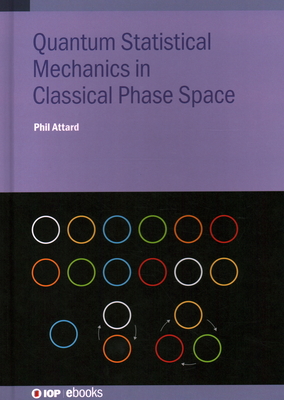
Quantum and classical results are often presented as being dependent upon separate postulates as if the two are distinct and unrelated, and there is little attempt to show how the quantum implies the classical. The transformation to classical phase space gives researchers access to a range of algorithms derived from classical statistical mechanics that promise results on much more favourable numerical terms. Quantum Statistical Mechanics in Classical Phase Space offers not just a new computational approach to condensed matter systems, but also a unique conceptual framework for understanding the quantum world and collective molecular behaviour. A formally exact transformation, this revolutionary approach goes beyond the quantum perturbation of classical condensed matter to applications that lie deep in the quantum regime. It offers scalable computational algorithms and tractable approximations tailored to specific systems. Concrete examples serve to validate the general approach and demonstrate new insights. For example, the computer simulations and analysis of the λ-transition in liquid helium provide a new molecular-level explanation of Bose-Einstein condensation and a quantitative theory for superfluid flow. The intriguing classical phase space formulation in this book offers students and researchers a range of new computational algorithms and analytic approaches. It offers not just an efficient computational approach to quantum condensed matter systems, but also an exciting perspective on how the classical world that we observe emerges from the quantum mechanics that govern the behaviour of atoms and molecules. The applications, examples, and physical insights foreshadow new discoveries in quantum condensed matter systems.
Log in to write a review for this book.
No reviews yet. Be the first to share your opinion.
Biography not available.