Shneider, Mikhail N Author
Biography not available.

Browse all FOLKLORE books
Browse all GARDENS books
Browse all GRAPHIC NOVELS books
Browse all HISTORY - MEDIEVAL books
Browse all HUMOUR books
Browse all Juvenile Fiction : Biographical - Other books
Browse all Juvenile Fiction : Historical - Other books
Browse all Juvenile Fiction : Legends, Myths, & Fables - Other books
Browse all Juvenile Fiction : People & Places - Other books
Browse all Juvenile Fiction : People & Places - United States - Other books
Browse all Juvenile Fiction : Religious - Other books
Browse all Juvenile Nonfiction : History - Other books
Browse all Juvenile Nonfiction : Mathematics - Advanced books
Browse all Juvenile Nonfiction : People & Places - Other books
Browse all Juvenile Nonfiction : People & Places - United States - Othe books
Browse all LITERARY STUDIES books
Browse all LONDON books
Browse all Medical : Nursing - Mental Health books
Browse all MIND books
Browse all MUSEOLOGY books
Browse all NON-CLASSIFIABLE books
Browse all NONLINEAR SCIENCE books
Browse all POPULAR SCIENCE books
Browse all RELIGIOUS STUDIES books
Browse all SPIRIT books
Browse all SPORT books
Browse all TRAVEL WRITING books
 Out of Stock
Paperback · ISBN 9780750360357
Inclusive of GST and other taxes
Arriving at your doorstep in 10-15 days
Our logisitcs team will make sure everyitem is delivered safely
| ISBN | 9780750360357 |
|---|---|
| Publisher | Institute of Physics Publishing |
| Publication date | December 2024 |
| Language | English |
| MRP | £25.00 GBP |
| Page count | 218 |
| Item weight | 86 g |
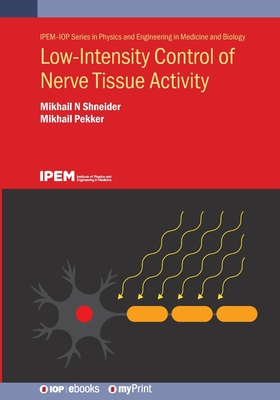
Our book is written primarily for biologists and physicians but also for physicists, engineers, and students who want to understand the mechanisms of stimulation and signal propagation in nervous tissue. It describes in detail the mechanism of ephaptic coupling, which involves the transmission of excitation from an active neuron to a nearby inactive neuron through a conducting intercellular medium. This connection plays an important role in the functioning of the nervous system.
The book explains how the interaction of the axon membrane with the electric field of low-intensity microwave radiation leads to a redistribution of transmembrane ion channels in the region of the initial segment of the axon, resulting in an increase or decrease in the threshold for action potential excitation, depending on the radiation intensity.
Key Features:
Incorporates understanding biophysical processes which open up the possibility of developing new material devices that can be used in medical practice, particularly in terms of pain management.
The authors believe that the book stimulates new experimental and theoretical research in the influence of weak microwave fields on the activity of the nervous tissue and physiological processes. Actual experimental techniques are incorporated where appropriate.
The materials presented in this book will be useful for engineers, scientists, and physicians in terms of the development of significant new advances in pain management.
It can be used for additional sections in undergraduate and graduate courses for students studying medical physics, biophysics and neuroscience.
Log in to write a review for this book.
No reviews yet. Be the first to share your opinion.
Biography not available.
Biography not available.